
IDEX Online Research: U.S. Specialty Jewelers’ Sales Slump in Holiday Season
February 18, 08
Specialty jewelers in the U.S. market reported a sharp decline in sales during December 2007, based on preliminary retail data from the U.S. Department of Commerce. Sales during the most important month of the year – a period when most specialty jewelers generate more than 20 percent of their annual sales and most of their yearly profits – were $6.6 billion, down 2.6 percent from December 2006.
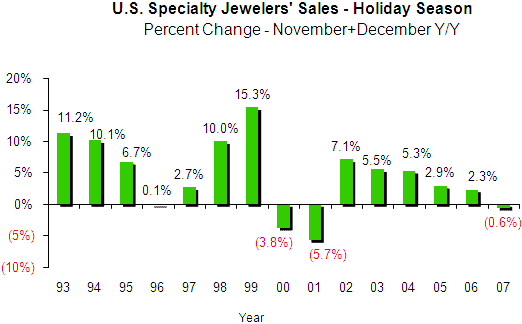
Furthermore, specialty jewelers’ sales for the all-important November-December Holiday Selling Season were $9.3 billion, down 0.6 percent versus the same period a year ago (2006) when jewelry sales were $9.4 billion.
Finally, as expected, the Commerce Department revised specialty jewelers’ sales for November downward, though we think we will see further downward revisions over the next few months.
Full Year Sales Show Modest Increase
For the full year ending December 2007, specialty jewelers’ sales were $30.9 billion, up a very modest 2.6 percent over the prior year’s $30.1 billion, according to preliminary figures just released by the Commerce Department. This compares to a 6.4 percent gain in the prior year. Because both of these sales increases in 2006 and 2007 for specialty jewelers were below total jewelry industry sales gains for 4.3 percent for 2007 and 6.5 percent for 2006 for all merchants – mass market, discounters, etc. – it suggests that specialty jewelers lost market share. Specialty jewelers’ 2007 sales of $30.9 billion were 48 percent of all jewelry sales of $64.8 billion in 2007 in the American market; specialty jewelers have been losing market share very slowly for many years.
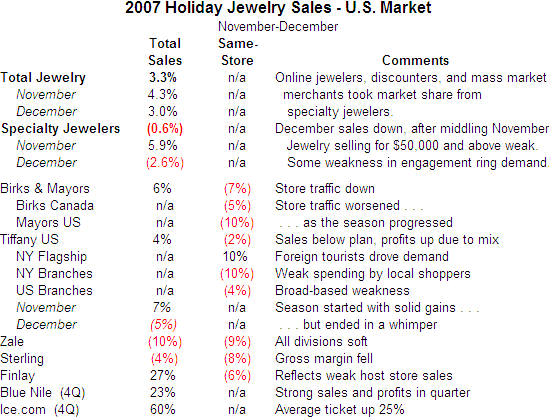
It may seem anti-climatic, but the scoreboard below summarizes preliminary “final” numbers for the all-important November-December selling season. While there will be minor changes in the percentages over the coming months as the Commerce Department revises its numbers, we do not expect to see more than a 20-30 basis point change – meaning that the November-December sales decline of 0.6 percent for specialty jewelers could become 0.3 percent or 0.9 percent, but probably won’t change beyond that modest range.
 Source: Company Reports |
Holiday Sales Less Important to Jewelers
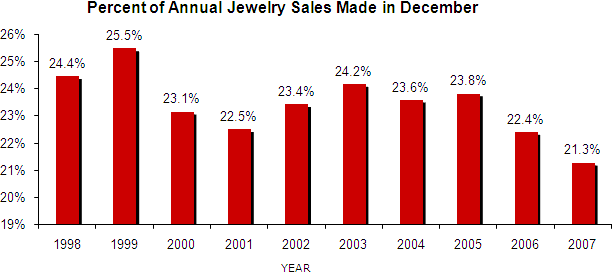
Just eight years ago, December sales were 25 percent of the typical specialty jeweler’s annual business. For 2007, they were 21 percent of their annual business. On the other hand, November jewelry sales have remained a stable 9 percent of annual revenues. In part, December sales were very weak in 2007, so we would have expected sales for that month to be a smaller portion of sales for the full year. However, the diminished importance of December sales is a trend that has been occurring for the past several years. Our view is that this is a positive trend – spreading sales across the year helps a jeweler control expenses such as payroll and support costs, and its lessens reliance on one make-or-break sales event during the year.
The graph below illustrates the trend in the diminished importance of December for specialty jewelers in the U.S. market.
 Source: US Commerce Department |
December and Holiday Jewelers’ Sales Weak
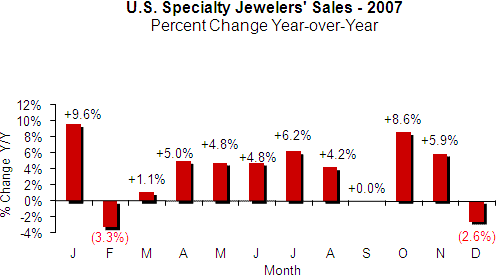
Specialty jewelers posted very weak sales for December and the all-important two-month Holiday Selling Season of November and December, based on preliminary data just released by the U.S. Department of Commerce. We had expected sales to be up by about 3 percent. Instead, sales comparisons for December were much worse than we had expected. With jewelry price inflation at the retail level running in the 4.6 percent range for the final quarter of the year, we believe that holiday unit sales were down at least 5 percent, and December unit sales were down close to 8 percent.
The graph below summarizes monthly sales comparisons on a year-over-year basis for specialty jewelers.
 Source: US Department of Commerce |
For the Holiday Selling Season of November and December 2007, specialty jewelers’ sales were down 0.6 percent from the same period in 2006, as the following graph illustrates.
 Source: US Department of Commerce & IDEX Online |
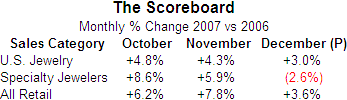
For the three months ended December 2007, the scoreboard for specialty jewelers’ sales, total jewelry industry sales and total retail sales is summarized in the following table. The figures show that specialty jewelers gained market share in October and November from non-traditional jewelry retail outlets (discounters, mass market retailers, department stores, etc.), but lost significant market share in December. Furthermore, jewelers lost market share to other retail categories which offered more enticing merchandise and more compelling values.
| |
Full Year 2007 Sales In Line With Expectations
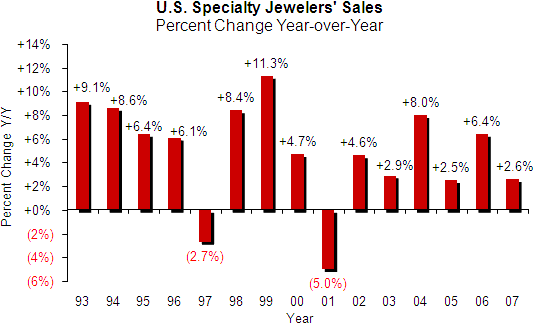
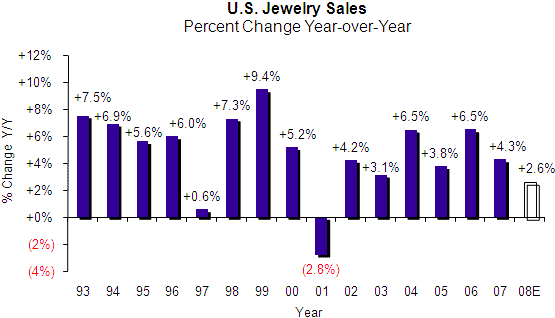
Despite a very weak 2007 holiday selling season, total sales for specialty jewelers in the U.S. market were up by 2.6 percent for the full year ended December 2007. However, it is important to understand that the price inflation rate at the retail level for jewelry was +4.9 percent for the year. Thus, it is likely that unit sales of jewelry in the U.S. market fell modestly for the year.
The graph below summarizes full year sales comparisons since 1993 for specialty jewelers in the U.S. market.
Source: US Department of Commerce
Jewelry Demand Weak Due to Many Factors
Jewelry demand slowed in the final quarter of 2007 due to many factors, including the following:
- High energy costs ate into consumers’ discretionary income – With gasoline prices near record-highs, coupled with high heating oil, propane, and natural gas prices, consumers had less discretionary income available for purchases such as jewelry.
- Other spending options were more enticing– When faced with the decision of whether to buy a flashy diamond or a fun GPS unit – both priced at $400 – the decision was easy: buy the fun GPS unit. Jewelers across the continent reported that they lost sales to consumer electronics gadgets. Mass market jewelry and mass market consumer electronics gadgets were both heavily promoted at the same price points during the 2007 Holiday Selling Season: $300-to-$500.
- Wealth under siege – The stock market was down, home values have been falling and unemployment has begun edging up. Further, the media hammered consumers with news about home mortgage foreclosures, though they neglected to mention that only a very tiny percentage of mortgages were at risk. This news and these trends unnerved consumers and caused them to tighten their purse strings.
- Lack of compelling fashion – Too many consumers said that they found nothing new in jewelers’ stores. There was no “must-have” jewelry merchandise this year.
- Competitive shopping experiences – Jewelers are rated as only an “average” place to shop, according to ad agency JWT in its jewelry industry Retail Landscape Study. That is a generous rating, in our view as a mystery shopper. It is not that jewelers have gotten worse. Rather, the competition has gotten better. The crowds at the Apple Computer stores, Bass Pro shops, and Build-A-Bear stores tell the story: consumers want an interactive shopping experience. Jewelers’ stores are full of barriers to an interactive shopping experience.
December Total Jewelry Sales Down
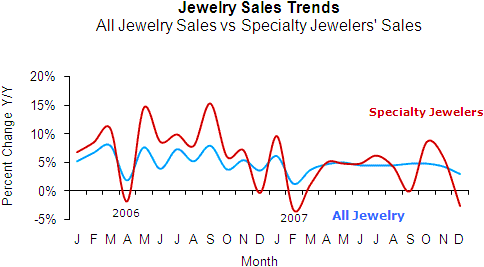
Revised government figures show that total U.S. jewelry sales comparisons had been relatively flat for most of the year. However, in the fourth quarter, sluggish jewelry demand led to weak sales comparisons on a year-over-year basis.
The graph below compares specialty jewelers’ sales trends (red line) to total jewelry sales trends (blue line) in the U.S. market. As the graph clearly illustrates, jewelry sales at specialty jewelers have been on a roller coaster ride for the past few months, with a sharp slide in December.
|
|
December Specialty Jewelry Sales Weaker Than Total Retail Sales
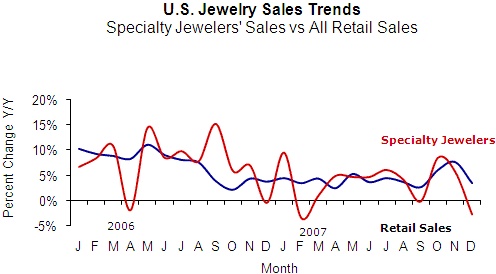
During December, specialty jewelers’ sales in the U.S. market declined by 2.6 percent. Retail sales, while soft, were up about 3.6 percent during the month, based on preliminary sales results. This, too, was below the forecast by the National Retail Federation which had predicted that retail sales would be up by about 4 percent.
The graph below summarizes sales trends for all retail goods (black line) excluding food and automobiles versus specialty jewelers’ sales (red line). Why do we eliminate “automobile” sales? Monthly auto sales are driven largely by consumer incentives rather than by underlying economic factors. Over the long term, auto demand trends are an important indicator of consumer vitality; however, on a month-to-month basis, auto demand is dependent on manufacturers’ incentives such as zero percent financing, cash-back offers and other deals. Food sales are far less cyclical and can mask changes in consumer demand; thus, we eliminate them too.
 Source: US Department of Commerce |
Consumer Spending Weakened at Year-End
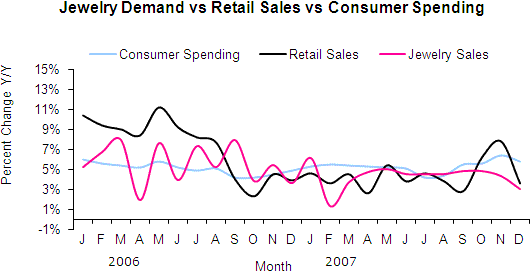
Despite price inflation of core commodities such as gasoline and food, consumer expenditures weakened during December 2007. This led to weakening retail sales and a decline in jewelry sales. Spending on services remained more-or-less on track.
The graph below summarizes trends in American’s total spending (blue line), retail sales of all goods (black line) and expenditures on jewelry (red line).
Source: U.S.Department of Commerce
Total Jewelry Industry Sales Up in 2007
Earlier this month, we reported preliminary 2007 sales for the total jewelry category in the U.S. market. Jewelry sales through all outlets – specialty jewelers, discounters, mass market merchants, specialty retailers and others – were up 4.3 percent in 2007 to about $64.8 billion. The full text of that article is available from IDEX Online under the “research” category.
Outlook: 2008 Will Be Disappointing for Jewelers
When the economy slows, jewelry demand evaporates. When the economy grows, jewelry demand soars. That’s the simple formula for forecasting jewelry sales.
Most economists seem to think the U.S. is already in a mild recession that is expected to last no more than two quarters, and a recovery is likely to begin in the third quarter of the year. If all goes well, the economy should be showing solid signs of growth in the all-important fourth quarter of 2008. The good news is that the U.S. Fed is trying to engineer a soft landing.
At this point, we haven’t published our official 2008 jewelry sales forecast. Currently, our very preliminary sales forecast for the U.S. jewelry industry calls for total industry sales to be up by 2-3 percent for the full year. This reflects a modest decline in unit sales, offset by continued rising price inflation. Unfortunately, specialty jewelers’ sales are expected to lag total industry growth slightly.
The graph below summaries our preliminary jewelry sales forecast for the U.S. market in 2008.
Source: US Department of Commerce NIP