
IDEX Online Research: Third Quarter Sales Soft for U.S. Jewelers
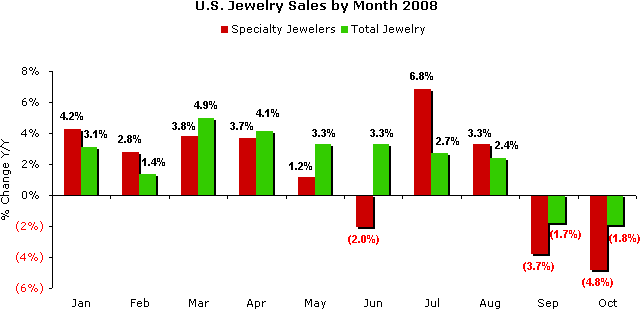
December 29, 08Not surprisingly, third quarter jewelry sales in the U.S. market were weak. After a weak May (Mother’s Day) and very weak June, specialty jewelers’ sales spiked hopefully in July. However, after that, any cause for celebration was wiped out. August jewelry sales were so-so, and the bottom fell out of the market in September and October.
The graph below summarizes jewelry industry sales by month for 2008. It is clear that jewelry sales soured in September, a trend that continues through today.
 Source: Company Reports |
Third Quarter Jewelry Sales Trends
The following summarizes third quarter sales for the total jewelry industry (all retailers including specialty jewelers, discounters, mass market merchants, online sellers, and others) as well as for specialty jewelers.
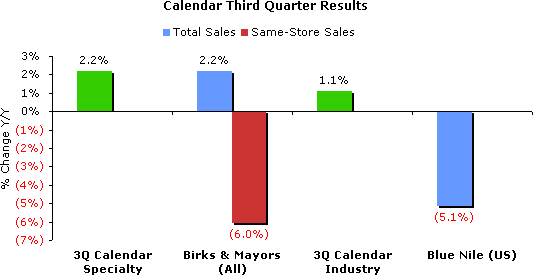
- Calendar Third Quarter – Total U.S. Jewelry Industry = +1.1 percent
- Calendar Third Quarter – Specialty Jewelers’ Sales = +2.2 percent
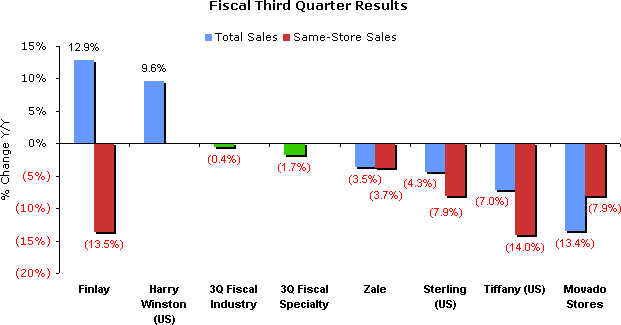
- Fiscal Third Quarter (End October) – Total Industry = (0.4 percent)
- Fiscal Third Quarter (End October) – Specialty Jewelers’ = (1.7 percent)
In both September and October, specialty jewelers’ sales were particularly hard-hit. No one was spared. Both higher-end and mass market jewelers felt the pinch as fear gripped the American public and consumers snapped shut their wallets.
Chain jewelers were particularly hard-hit because consumer traffic in America’s shopping malls fell substantially. However, the decline in customer traffic was offset by shoppers seeking value-priced jewelry at price-points that many mass market chain jewelers sell. Preliminary results show that these trends continued into most of November, though there was some recovery around Thanksgiving, with a fall-off in early December.
Who lost market share? Unfortunately, most of the publicly held jewelers lost market share in September and October, after posting solid sales gains during the summer.
Who picked up market share in September and October? Multi-line retailers – particularly discounters and mass merchants such as Wal-Mart and others – were the beneficiaries of shoppers who have significantly tightened their purse strings.
Some U.S. jewelers – Blue Nile, Birks & Mayors – report financial results based on a calendar quarter, so their revenue summary reflects sales from July, August and September. All of the other key publicly held jewelers – Zale, Signet, Finlay, Tiffany, Movado, and Harry Winston – report sales over a fiscal quarter including August, September, and October. Because sales dropped off a cliff in September, those jewelers who operate on a calendar quarter basis did not report numbers nearly as disappointing as those jewelers who report on a fiscal quarter basis (three months of August, September and October).
The following graph summarizes sales for the third calendar quarter for the industry and specialty jewelers (green bars) as well as Blue Nile and Birks & Mayors, both of whom report financial results on a calendar quarter basis (blue bar = total sales; red bar = same-store sales).
Source: Company Reports
Company Highlights for Third Calendar Quarter
Birks & Mayors – Total revenues up 2.2 percent; U.S. same-store sales down 6 percent.
- Sales of merchandise over $20,000 retail were the strongest category for Birks & Mayors. As a result, the company’s average ticket rose, though management did not disclose the actual average sale value. However, customer traffic in Birks & Mayors’ stores was down.
- Demand for statement jewelry was strong in both the U.S. and Canadian markets.
- Demand for watches remained relatively strong at Birks & Mayors, but management said fine jewelry as a category suffered from weak demand.
- Reported inventory per store fell by 5 percent on a same-store basis. However, when currency translation and new stores are eliminated, inventory per store rose by just over 5 percent. Either way, we are impressed with management’s ability to control inventory in a volatile sales environment.
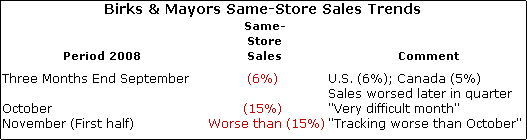
- The company reported that its same-store sales for all stores, in both Canada and the U.S., were down 6 percent in the three-month period ended September. Management indicated that sales deteriorated toward the end of the quarter. Same-store sales declined by 5 percent in Canada and were down by 6 percent in its U.S. stores.
- Birks & Mayors’ October same-store sales fell by 15 percent. The company did not break out same-store sales by market – U.S. versus Canada – but we believe that U.S. same-store sales fell by around 20 percent in October.
- Management said that November month-to-date sales (first half of the month) were tracking worse than October sales trends. The table below summarizes the company’s recent sales trends.
Source: Company Reports
Blue Nile – Total revenues declined by 2.9 percent in the three-month period ended September 2008.
- U.S. sales were down by 7 percent, continuing a trend of disappointing comparisons that began earlier this year. Sales in Blue Nile’s overseas markets – all relative immature markets – were up 53 percent, a notable number, but down dramatically from the 179 percent gain posted in the second quarter.
- The number of orders fell by 6 percent during the third quarter. The average ticket rose by 3.1 percent to $2,159 in the three-month period. Blue Nile’s average ticket is about double the average ticket for a typical guild jeweler and more than six times the level of the average ticket for a mass market jeweler.
- Sales of jewelry priced above $100,000 retail and in the range of $5,000 to $25,000 were the weakest categories. Jewelry in these two price ranges are “aspirational” categories for certain types of customers. However, sales of merchandise priced below $5,000 and between $25,000 and $100,000 rose in the quarter.
- Management said that it had not seen a decrease in the number of credit approvals in the quarter. However, it noted the exact opposite in the second quarter, when management said that credit approvals were down. We believe that Blue Nile’s credit sales mix is down.
- Blue Nile’s October sales declined by 20 percent. Management did not provide a break-out of sales by market, but we estimate that U.S. sales were down by 22-24 percent while overseas sales were likely up by 30 percent or so.
Company Highlights for Third Fiscal Quarter
The following graph summarizes sales for the third fiscal quarter for the industry and specialty jewelers (green bars) as well as those retail jewelers who report sales on a fiscal quarter (August, September, October) basis.
Source: Company Reports
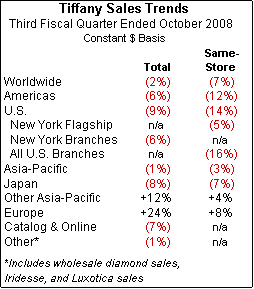
Tiffany & Company – Tiffany’s total U.S. sales were down 9 percent, while same-store sales declined by 14 percent. Sales were disappointing in all of Tiffany’s markets, except the Asia-Pacific region (excluding Japan) and Europe. The table below summarizes total sales and same-store sales by operating division for the three-months ended October 2008.
 Source: Tiffany & Co |
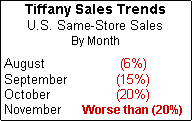
- In the U.S., sales deteriorated as the quarter wore on. In August, same-store sales declined by 5 percent. By the end of the quarter, U.S. same-store sales were down 20 percent. Management said that November sales trends were worse than October sales levels. Tiffany’s branch same-store sales declined by 21 percent in October. The following table summarizes Tiffany’s same-store sales by month in the U.S. market.
Source: Tiffany & Co
- Tiffany management cited three key reasons for its sluggish sales: 1) a slowing global economy; 2) frozen credit markets; and 3) plummeting equity markets.
- The substantial sales decline in the U.S. market was broad-based. However, sales in Tiffany’s flagship Fifth Avenue store declined only slightly, since overseas customers helped maintain demand.
- The average transaction size rose slightly in the U.S. market. Management did not disclose the actual dollar amount of the average transaction.
- A price stratification demand analysis showed weakness in sales and transactions across the board at most price levels with no meaningful differences.
- E-commerce and catalog sales declined by 7 percent in the quarter due to fewer orders. However, the average transaction value rose somewhat.
- Retail sales in Canada, Mexico and Brazil were up double-digit percentages in the quarter. Online sales in Canada were strong.
- Sales in Tiffany’s Iridesse pearl stores declined, and were below expectations.
- Statement jewelry sales were down in the quarter, though they rose slightly in overseas markets.
- Sales of fine jewelry collections declined modestly worldwide for Tiffany, dragged down by weak demand in the U.S. However, sales of collections rose in other global markets, especially in the Asia-Pacific region.
- Worldwide engagement jewelry sales rose by a single digit level, but posted a small decline in the U.S. market. However, Tiffany reported strong growth in wedding bands.
- At more modest price points, fashion jewelry sales were up in the quarter due to strong demand for silver and gold charm jewelry collections, with particular strength in Europe.
- Designer jewelry sales were down in the quarter, with pronounced softness in the U.S.
- While watch sales were soft, management continued to talk up its strategic alliance with the Swatch Group. This alliance should add meaningfully to Tiffany’s 2009 watch offerings.
Movado – Retail sales – Total retail sales in the company’s 61 stores were down 13 percent in the third quarter. Same-store sales fell by nearly 8 percent. Same-store sales in the Outlet stores were up slightly, while same-store sales in the company’s Boutique stores were down notably (management did not provide exact same-store sales results by division). Retail sales were 17 percent of corporate revenues in the most recent fiscal year.
The comments below relate to the company’s manufacturing and wholesale division. However, these sales trends reflect retail demand for watches by price points and brands.
- Sales in the luxury watch category – brands including Ebel and Concord, as well as some watches branded Movado – were down 29 percent (adjusted) in the quarter. Sales of luxury brands were down broadly across all geographic areas.
- Sales in the accessible luxury watch category – mostly Movado branded goods – were down 35 percent, mostly due to weak demand in the U.S. market.
- Sales among licensed watch brands – ESQ, Coach, Hugo Boss, Jiicy Couture, LaCoste and Tommy Hilfiger – were up just over 8 percent due to growth in international markets.
Zale Corporation – Total sales fell by 3.5 percent in the third fiscal quarter; same-store sales were down 3.7 percent. The company does not disclose sales by geographic division (U.S. versus Canada) or by brand.
- Sales by division were as follows:
- Fine jewelry stores - $314.0 million, a decline of 3.6 percent from the prior year.
- Kiosks - $47.0 million, a decline of 3.0 percent from the prior year.
- Other - $3.1 million, a decline of 1.6 percent from last year.
- Sales weakened as the quarter progressed. October same-store sales fell by 9 percent. Weak sales trends continued into November, with a sales decline in the mid-teen range.
- The average ticket rose by 2 percent in the quarter versus the same three-month period last year.
- The number of customer transactions fell by 6.1 percent in Zale’s fine jewelry stores.
- The warranty attachment rate was 55 percent in the quarter versus 58 percent in the prior year. Warranties add both revenue and profits for jewelers.
- During the quarter, Zale management focused on the launch of its proprietary Celebration Diamond with an average ticket of over $600 or almost double the corporate average ticket.
- The company’s Pacesetter stores – 135 units that are retail laboratories – are posting sales gains about six percentage points better than the rest of Zale’s store base. Further, the gross margin in the Pacesetter stores is running about 200 basis points (two percentage points) higher than non-Pacesetter stores.
- Management said that its customers are “voting for newness” – they want something different from the run-of-the-mill product that far too many jewelers are showing. Because Zale has increased its level of new products, the company is seeing a higher average ticket and a greater gross margin among the new product categories.
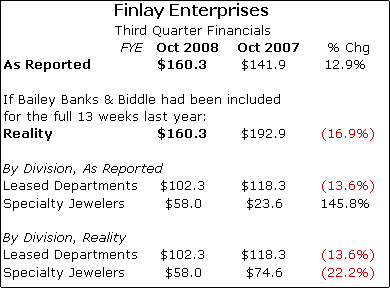
Finlay Enterprises – Reported total sales in the third quarter rose by 12.9 percent over the same period last year. The entire increase was driven by the Bailey Banks & Biddle stores which were acquired in November 2007. Management did not give much narrative detail about its sales deterioration, but it did provide enough numbers that we were able to analyze trends during the quarter.
- The company reported that total sales were up by 12.9 percent. While that is technically correct, it does not provide a snapshot of current trends. If Bailey Banks & Biddle had been included in last year’s third quarter for the full thirteen weeks, Finlay’s revenues in the third quarter of 2007 would have been $192,936, rather than the reported $141,918. The table below illustrates the “apples-to-apples” revenue comparisons for the third quarter.
Source: Company Reports
Based on numbers in the company’s legal filings, Finlay’s third quarter total revenues were actually down by nearly 17 percent. The largest shortfall came in the specialty jewelry division which consists of Bailey Banks & Biddle (67 stores), Congress (5 units), and Carlyle (35 units). Revenues in this division were off by just over 22 percent, if BBB had been included for the full third quarter last year.
The company’s leased department division posted sales that were down 13.6 percent. Finlay operates leased departments in 216 Macy’s Central stores, 57 Macy’s North units, 36 Macy’s Northwest stores and 34 Bloomingdale’s units, for a total of 343 leased departments. At the end of 2008, Finlay will close 93 Macy’s leased departments. Further, Finlay will close 47 Lord & Taylor departments next month.
- The company reported that its third quarter same-store sales fell by 14.9 percent, including the Macy’s and Lord & Taylor units that are slated to close at year-end. Excluding these discontinued operations, Finlay’s same-store sales fell by 13.5 percent in the third quarter.
- The following table summarizes sales by product category for Finlay. The percentage change (far right column) is year-to-date; all other data is for the third quarter. The numbers represented the company’s “reported sales,” unadjusted for the inclusion of BBB for the full three-month period last year or other adjustments.
|
|
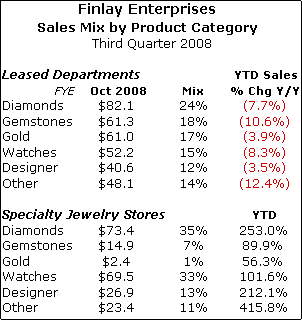
A typical specialty jeweler generates about 50 percent of its sales from diamonds and diamond jewelry. Clearly, Finlay’s leased departments are well below this industry average. What’s surprising is that the diamond sales mix at its specialty jewelry stores is also below the industry average. Based on the numbers, BBB will help push up the diamond sales mix in future periods.
(Finlay’s “other” product category shown on the table above consists of special promotions, remounts, estate jewelry, pearls, beads, CZ, sterling sliver, men’s, and repair.)
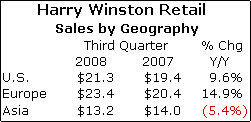
Harry Winston – Harry Winston’s total retail sales rose by a relatively robust 8 percent in the third quarter ended October 2008. Management did not provide many details about its stores’ performance, but the following information was included in its legal filings.
- Management said that diamond sales were strong in the Middle East and parts of Asia.
- Sales grew in its eight U.S. stores, two European stores, and three Asian stores. However, sales in the five stores in Japan were weak.
- Sales started strongly in the quarter, but weakened as the three-month period progressed.
- The following table summarizes sales by geographic area for Harry Winston’s retail operations.
Source: Company Reports
Specialty Jewelers’ Sales Often Fare Worse in Recessionary Periods
For reasons that aren’t entirely clear, specialty jewelers fare poorly in recessionary periods.
- Specialty jewelers’ sales are usually weaker than total industry sales in recessionary periods.
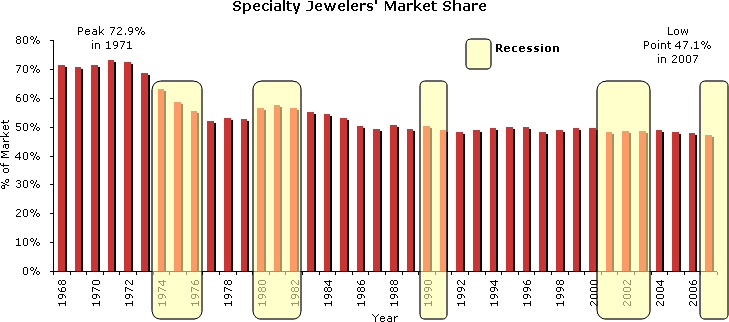
- Specialty jewelers tend to lose market share more rapidly in recessionary periods (except for the 1980-82 recession), and they don’t recover that market share when the economy recovers.
- Specialty jewelers have lost substantial market share over the past four decades. At their peak in 1973 (reliable data goes back only to the late 1960s), specialty jewelers’ sales represented nearly 73 percent of total U.S. jewelry industry sales. The balance of jewelry sales during that period were made by retailers whose primary business isn’t jewelry: mass marketers, catalog showrooms, and others. By 2007, specialty jewelers’ sales have fallen to about 47 percent of total U.S. jewelry sales.
- Unfortunately, there is no reason to believe that these trends will be different in the current environment.
The graph below illustrates how specialty jewelers have lost market share over the past several decades. Ironically, just as jewelers appeared to be regaining market share in 1980 and 1981, the U.S. economy hit the skids, and they lost significant market share over the following decade.
 Source: NBER, BLS, JIRI, US Dept of Commerce |