
IDEX Online Research: U.S. Jewelry Demand Very Strong, But Profits Elusive for Jewelers
December 19, 06
The third calendar quarter of the year is the least meaningful of the year for the U.S. jewelry industry: only about 19 percent of an American jeweler’s annual sales are generated in the months of July, August, and September. This is no surprise, since there is no major gift-giving occasion such as Valentine’s, Mother’s Day, or Christmas in this three-month period.
However, during the third quarter, jewelers can gain some insight about what merchandise will sell during the upcoming all-important fourth quarter holiday selling season. In addition, they can see the likely impact of new merchandise on margins as well as the possible costs that will eat into profits. Thus, the third quarter can be an important indicator of the future – especially the fourth quarter when just under 40 percent of all jewelry sales are generated.
The following is a summary of third quarter jewelry retail trends in U.S. markets.
Sales Mixed
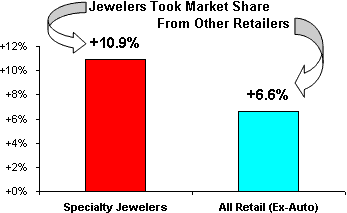
During the third quarter, U.S. jewelers took market share from merchants in other retail categories. As the graph below illustrates, total jewelry sales grew by 10.9 percent in the third quarter while total U.S. retail sales grew by a more moderate 6.6 percent.
| Third Quarter 2006 Sales Trends Source: Dept of Commerce |
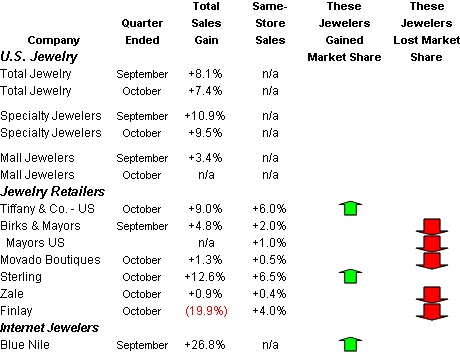
Sales growth ranged from minimal to strong in the October quarter. The high-end jewelers generally reported the strongest sales gains, while mass market jewelers – with the exception of Sterling – generally reported puny sales increases in the three-month period.
The table below summarizes sales gains for the jewelry industry as well as for specific publicly held U.S. jewelers.
| Third Quarter Jewelry Sales |
Sales were driven by the following factors:
- Journey – The surprise of the season has been the strength of the latest DTC promotion: Journey diamonds. With the experience of Right Hand Rings still echoing in their minds, many retailers opted to tiptoe into Journey diamonds. Journey diamonds were strong right out of the starting gate, and appear headed higher in 2007.
- Circle Diamonds – Circle diamond jewelry has been strong all year, despite worries by jewelers that demand of this relatively mature product line might be about to slow.
- Big Diamonds – Diamonds appear to be the strongest jewelry category, with big diamonds – two carats and larger – showing particularly large sales gains. Consumers appear to want “flash for cash,” and the only way to get it is with either a single large diamond or with many diamonds that Journey and circle jewelry offer.
- Alternative metals – Some jewelers reported that alternative metals are strong. Tiffany has a stainless steel collection that is showing solid sales gains. A few jewelers have introduced palladium jewelry as an alternative for platinum; initial demand appears to be strong. In addition, jewelry with mixed metals appears to be strong.
- Diamonds and colored gemstones – Consumers are buying diamond fashion jewelry with colored gemstone accents.
- Luxury watches – Almost every jeweler mentioned that branded luxury watch sales were very strong. Consumers apparently are willing to pay for the high-priced brands such as Rolex and others.
- Expensive jewelry – Nearly every jeweler reported that sales were strongest among their highest priced goods. Tiffany says jewelry that sells for $20,000 and higher is its strongest category. Other jewelers report that while the number of sales transactions is either flat or down modestly, the average ticket has risen sharply.
- Moissanite – It seems moissanite ads are everywhere. Between Finlay’s department store moissanite sales efforts and J.C. Penney’s major moissanite promotional push, consumers apparently have begun to embrace moissanite in a big way. When it is properly positioned and sold, it can be a significant source of additional business for retail jewelers.
- Designer goods – Even if the designer is unknown, there is a certain allure that has captured consumers’ attention: they want “designer” goods.
- Collections – Tiffany is the king of collections, and the company continues to roll out enhancements to its major jewelry collections. Movado has also discovered that watch collections sell well, too. Gordon’s has introduced its new “Love” collection which appears to be selling well.
- Silver – This inexpensive metal is in demand, both at the high end in designer goods as well as at the lower end at stores like Piercing Pagoda which sell starter goods.
- CZ – At the low end, CZ appears to be enjoying somewhat of a renaissance. Piercing Pagoda reports that CZ jewelry represents about 30 percent of its sales.

Most jewelers reported that their gross margins were under pressure. This reflects continuing margin pressure due to a number of factors, including the following:
- Higher materials costs – Virtually every commodity used in jewelry – diamonds, precious metals, etc. – have risen in price over the past two years. Retail jewelers say they haven’t been able to pass along those costs fully to their customers. The following table illustrates recent commodity cost increases.
Commodity Cost Increases 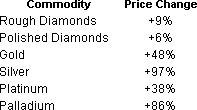
Souce: Market Prices
- Higher LIFO charges – Reflecting higher procurement costs for jewelry, most retail jewelers report that their LIFO charges – which reflect the higher costs associated with new merchandise – rose sharply in the third quarter. Some jewelers’ LIFO costs doubled in the quarter.
- Discontinued merchandise – Jewelers recognize that they need to keep their retail assortments fresh. As a result, many have increased their allowances for discontinued merchandise. They are melting jewelry sooner, and they are selling it off at huge discounts or selling it to a liquidator, if it does not sell. While this depresses jewelers’ margins, it helps boost inventory turns. Jewelers are learning that it may be better to take a shorter margin, but achieve higher inventory turns, in their quest for overall profitability.
- Direct sourcing – Zale is the latest to embrace direct sourcing, and it is having a significant positive impact on its margins. In addition, apparently the threat of direct sourcing has caused some of its vendors to revise their pricing of goods to Zale.

Operating Expenses Up
Operating costs are climbing faster than sales are increasing for most jewelers. Thus, their operating expenses had a negative impact on pretax margins during the October quarter.
- Payroll, benefits, and professional fees – This is the usual list of culprits which pushed up retailers’ operating expense ratios. Jewelers’ lament: “everyone is getting a salary increase except the owners.”
- Bad debt – Only one retail jeweler reported bad debt – Sterling. Management said that bad debt in its U.S. stores dropped significantly from the same period last year – from 3.2 percent of sales to 2.9 percent of sales this year. On the other hand, Movado increased its reserve for bad debt in its manufacturing division; management was not forthcoming with a full explanation about this non-cash accounting charge.
Jewelers’ Outlook Generally Positive
Holiday advertising and marketing – As jewelers compete increasingly with non-traditional channels of distribution – discounters, mass merchants, online retailers, and others – their advertising has become more aggressive. Most of the major chains plan to increase their spending on national network television. They also said that ad spending during the week prior to Christmas would be heavier than in past years.
Proprietary brands and merchandise – Most jewelers talked about increasing their sales mix of proprietary merchandise, including exclusive brands as well as brands with their store name. This is one method of boosting margins.
Full retail price – Jewelers, like used car dealers, have traditionally played “pricing roulette.” However, we’ve heard more jewelers claim that they are selling merchandise for the full price, and trying to cut back on store-level discounting.
Expansion – Other than Sterling jewelers which is opening new store square footage at a rate of 8-10 percent annually, no other major publicly held jeweler is generating significant net expansion. Zale has ramped up its new store openings somewhat, but it has recently closed a large number of big Bailey Banks & Biddle stores, so its square footage gains are virtually nil.
Gold leasing arrangements – Finlay is one of the last among major retail jewelers to close out its gold leasing program. Gold leasing works best when prices are stable or declining. But when gold prices rise, the costs can be devastating.
Forward hedge contracts – Zale has begun to utilize forward hedge contracts in an effort to smooth cash flow and fix its gold and silver costs. However, because of accounting rules, these contracts can introduce significant swings in quarterly financial results.
Other new promotions – Zale has rolled out its Lifetime Extended Service Agreements across all of its brands.
Online Jewelry Retailers
At the end of the third quarter, there were three “pure plays” in online jewelry retailing: Blue Nile, Odimo, and Abazias.
Since the end of the third quarter, Odimo has announced that it has ceased online retailing. Further, by the end of the year, it will be a shell company looking for a business. The stock, which came public for $9 per share in early 2005, was selling for pennies per share recently.
Abazias is posting dramatic sales gains, but its revenue base is still extremely small by comparison to any of the other publicly held online jewelers or store-based specialty jewelry merchants.
The following table summarizes sales and profits for the third quarter ended September 2006 for the pure-play online jewelers.
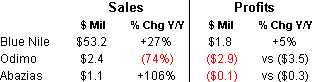 Source:Company Reports |
The only other online merchant to report jewelry sales for the third quarter was Amazon.com. Amazon’s management reported that engagement ring and gemstone sales grew by 108 percent versus the same period a year ago. Watch sales were up 122 percent over last year’s third quarter. Amazon does not provide the actual dollar value of its jewelry and watch sales, so it is unclear how much sales volume these categories generate for the company.