
Moscow Diamond Bourse Celebrates WFDB Membership
December 17, 06
The Moscow Diamond Bourse (MDB) hosted leaders of the international diamond and jewelry industries at an event last week. The Bourse celebrated its acceptance in June as a member of the World Federation of Diamond Bourses (WFDB).
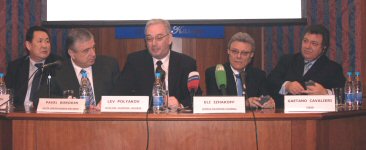 Sitting (from left) Boris Borisov, Pavel Borodin, Lev Polyakov, Eli Izhakoff, and Gaetano Cavalieri |
Eli Izhakoff, chairman of the World Diamond Council and honorary life president of the WFDB, said that with the privileges that come with membership in the Federation, also come many responsibilities. He urged MDB members to study the WFDB bylaws and adhere to them, emphasizing the need to be knowledgeable of the Kimberley Process.
“Naturally,” he added, “the government must offer its support and allow this industry to grow by giving it the chance to compete against other centers.”
CIBJO’s President Gaetano Cavalieri told the gathering, “It is my experience that worldwide, the development of the jewelry industry has a beneficial influence on local economies. As Russia is joining the World Trade Organization, your country will benefit from developing its super economy under the WTO banner.”
Vitaly Basygysov, director of the Precious Stones and Metals Committee of the State Duma (parliament), talked about the rapid changes the diamond and precious metals market had undergone in the past decade and a half. An industry once entirely owned and managed by the government, new laws now allow private enterprises to own and develop the sector. However, he added, that there was a dire need for more changes – in attitude and in practices.
“We are entering WTO and we need changes that will put us on an equal foothold with other countries, so we have equal competitive conditions,” he told the audience. “The government is considering more new laws aimed at liberalizing the trade, but they are being delayed. To push things forward, we are organizing hearings and meetings with members of parliament to advance the implementation of new legislation.”