
IDEX Online Research: Boomers Cut Back on Jewelry Expenditures
August 07, 08
After cutting back on jewelry expenditures for the past four years – 2001 through 2004 – Baby Boomers age 45-54 stepped up their spending dramatically in 2005. Unfortunately, this trend did not extend into 2006. Rather, Boomers’ jewelry spending reverted to levels established earlier in this decade.
Boomers Are A Bust
For years, demographers have been predicting that wealthy Boomers would spend heavily on luxury goods such as jewelry. Throughout the early part of the decade, jewelers waited patiently for Boomers to come into their stores. Finally, in 2005, Boomers stepped up their jewelry spending, and jewelers looked forward to a bright future serving those customers. Results for 2006 brought the disappointing news that Boomers did not continue to spend on jewelry at the same rate as in 2005. This leads us to conclude that 2005 data was probably an anomaly.
Despite erratic data, the bottom line is this: when jewelers see gray heads walk into their stores, they need to be prepared to make a sale: Boomers have the money, but jewelers haven’t done a good job of performing a walletectomy. (“Walletlectomy” is one of Warren Buffett’s favorite words; Buffett heads Birkshire Hathaway which has made significant investments in the jewelry industry.)
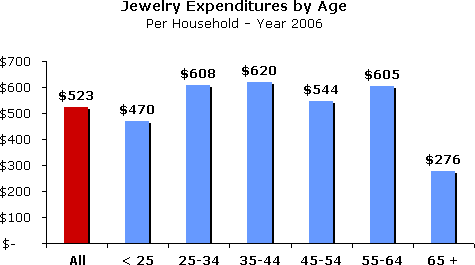
What’s the bottom line analysis of the new data related to age of jewelry shoppers? The answer is simple (and exactly what we said last year): age is not a reliable indicator of a consumer’s willingness to buy jewelry; income remains the best predictor of jewelry purchasing propensity. The graph below summarizes jewelry expenditures by age for 2006.
|
|
The graph below compares and contrasts jewelry expenditures by age for 2006 with average jewelry expenditures over a five-year period by age group of consumers. The percentages shown represent an average of spending above or below the norm for 2006 (red bars) and the prior five years (blue bars).
|
|
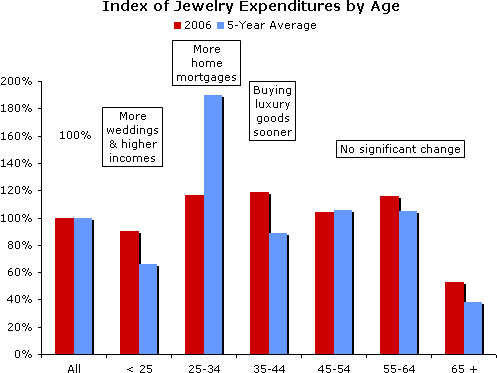
One of the biggest surprises – and disappointments – is the cut-back in jewelry expenditures by younger consumers age 25-34 in 2006. We can only hope this is an anomaly. These consumers have ample money, but below average discretionary income. Further, they are into “experiential spending” – trips and life experiences, as well as consumer electronics. A gadget might be obsolete in a year while a diamond may be forever, but too many young consumers are opting for a new gadget.