
IDEX Online Research: Specialty Jewelers’ Market Share Declines to Record Low
March 21, 10
In the recessionary environment over the past two years, U.S. specialty jewelers have lost significant market share in the competitive battle with multi-line discounters and other merchants who are also vying for consumers’ jewelry expenditures.
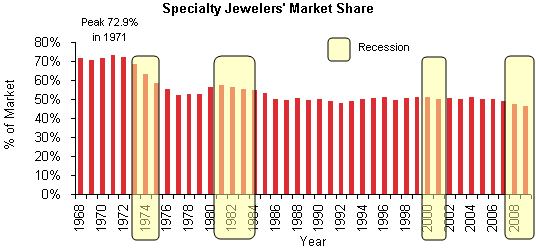
The latest data shows that specialty jewelers held a 46.2 percent market share in 2009, based on their sales of $27.2 billion versus total jewelry sales of $58.8 billion. In other words, specialty jewelers sold less than half of all jewelry consumed by American consumers. This is nearly a one percent decline from specialty jewelers’ 47.1 percent market share which they held in 2008. As recently as 2005, specialty jewelers sold just over half of all jewelry purchased by U.S. consumers.
These figures come as no surprise. In almost every recession over the past four decades, specialty jewelers have lost market share, and never seem to be able to regain it.
Specialty Jewelers’ Historic Market Share High
In the late 1960s and early 1970s, specialty jewelers sold nearly three-fourths of all jewelry in the U.S. market. Specialty jewelers’ market share peaked at 72.9 percent in 1971. Since then, their market share has steadily eroded, with significant declines in recessionary period.
The graph below summarizes specialty jewelers’ market share since 1967. Recessionary periods are shown in the yellow shaded areas.
Source: NBER, BLS, JIRI, U.S. Dept of Commerce
Specialty Jewelers’ Sales Dip Substantially in Recessions
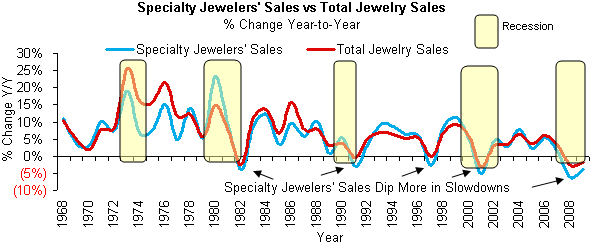
Unfortunately, U.S. specialty jewelers’ sales have declined more sharply in a recessionary period than sales of other retailers who sell jewelry. There could be several reasons for this trend:
· Specialty jewelers’ failures increase in recessions – As the number of specialty jewelers declines, multi-line discounters pick up market share.
· Other merchants become more aggressive during recessions – Sensing blood, some financially strong multi-line merchants implement strategies to take market share from weaker competitors – often small under-capitalized mom-and-pop merchants – thus ensuring the demise of weak retailers.
· Specialty jewelers are not perceived as “value” merchants – American consumers know Wal-Mart’s prices are among the lowest. In recessionary times, consumers tend to view “low prices” as “best value.” As a result, specialty jewelers who may carry better quality merchandise at higher price points are not perceived as offering “value.” If a shopper sees an engagement ring at a specialty jeweler for $3,000, but sees what he or she perceives as the same ring at Wal-Mart for $2,000, the consumer perception is that the specialty jeweler is overcharging, regardless of the fact that the rings are really not identical.
· Consumers cut back on recreational shopping – A significant portion of jewelry sales are impulse purchases. If shoppers stay out of the malls during recessions, they won’t make impulse purchases.
· Consumers shop at fewer retailers during recessions – When merchants’ sales slow, they often cut back on the number of vendors they use. The same is true of consumers: when they cut their budgets back in recessionary times, they tend to concentrate their spending at a few retailers.
There are many other reasons that specialty jewelers may lose market share in recessionary periods, but these are illustrative of the roadblocks that specialty merchants face, when competing with discounters such as Wal-Mart.
The following graph shows that specialty jewelers’ sales decline more sharply in recessionary periods, but unfortunately do not surge upward during an economic recovery. As a result, specialty jewelers never seem to regain market share that they lose in a recession.
Source: NBER, BLS, JIRI, U.S. Dept of Commerce