
{from concept to customer} It’s not all Bling Bling at Bada Bling
October 17, 04
For more than 20 years, Barry Bling has unwittingly driven a roller-coaster car, never knowing when the dips are coming, praying for a few moments of relaxation when the car drives on a level ground and waiting with excitement for the heady journey up the inclines. From the heyday of the eighties, the dips of the nineties, the sharp incline up to the millennium peak and the steady and slow increase of recent years, bling thought he had seen it all.
Bling’s success in the industry has been led by his belief in the distinction of service.
 |
Bling today is the CEO of a global jewelry manufacturing firm. His company owns plants in the
Over the past two years, he’s established brand lines, in addition to his non-label pieces. He has moved a significant part of his manufacturing to countries with lower labor costs. He has fought issues with his partners and learned to navigate his way around the bureaucratic obstacles of alien lands. He has begun sourcing more and more goods directly thus cutting out his wholesalers and has invested a small fortune in marketing and consumer advertising. Bling isn’t alone in trying to out-swim this fast-moving jewelry current, he and many others are wondering how long it can go on and whether in the end they’ll sink or swim.
The jewel of the Bada Bling crown is a brand-new plant in northern
 |
The opulent entrance hall to the plant is lined with glass cabinets displaying awards for both civic and business excellence. “We began, continued and will always be service based,” he told a group of recent GIA graduates during a regional career-fest.
Bada Bling began as a small operation specializing in wedding rings, servicing mainly independent retailers. They soon realized the need, however, to provide independents with not just a product but related services such as restyling, repair work, special orders and, most importantly, quick delivery. From wedding rings they branched out into offering component pieces, blank mountings and other manufacturing materials. “I wanted to give my customers added value, basically anything that would help them,” he relates.
Over in
Behind the foyer, past the glass cabinets, leaving the bowls of candy in the background, lay the beating heart of Bling’s life. Heavy security doors manned 24/7 by guards lead into a Willy Wonka-type factory making jewelry not chocolate bars.
Cell phones have to be checked in, all jewelry removed and then you’re into an area where kilos of gold race past on trolleys and huge circles of silver are melted, chopped and molded into exquisite, carved rings.
So how, we asked Bling, is a piece born? Which comes first we asked, the chicken or the egg?
This is where all the tentacles of Bling’s empire come into play. By working together in harmony, each tentacle, spread in the various corners of the world, communicates to the main body in the
 |
Most of the company’s diamond sourcing takes place in
But, we asked again, do the designers tell the buyers what to buy or is it the other way around? According to Bling and his jewelry manufacturing colleagues, it’s a bit of both. The company’s designers, both in the
Bling then takes us to the diamond sourcing room, a good 10-minute quick walk down the spotless, pinkish painted corridor. Windows allowed us to peek into the rooms holding thousands of molds, or vast vats with heavily protected workers pulling out melted gold. Each window was another opening into a different part of the process.
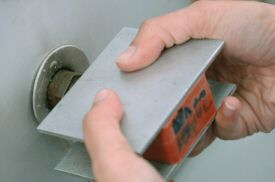
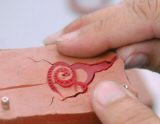
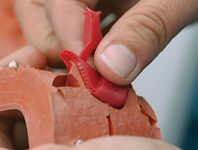
Inside one window workers could be seen patiently extracting masts of rings from blocks of vulcanized rubber. Every item produced by Bada Bling is assessed at each step of its journey through the factory, be it in the
Into the diamond room, and the head diamond buyer is sitting behind an overflowing desk with urgent paperwork dating back a month or so. This is not a job for those with a fear of flying. Every month he racks up the air miles, flying between
There’s a similar problem with the price of materials. Now the headache has spread to Barry. During a chairman’s lunch a couple of months ago (a time when Barry calls all his VPs in to get a lowdown on the latest industry gossip, rumors and, occasionally, actual news) one of the VPs pointed out that the price of gold was low and all economic indicators demonstrated that it wouldn’t be moving for at least four or five months. The VP of product development went back to his office, called his research team and within a week had produced a line that, according to his market survey, received a ‘would buy’ mark from 70% of consumers. After this data was shown to retailers, huge orders were placed. Almost every major jewelry chain and several of the department stores placed orders and the company’s sales team were busy crossing the
Now, contrary to expectations, the price of gold has shot up and Barry has no choice but to take a battering on the line. He remembers something Jonathan Goldman of Frederick Goldman said a year or so ago. “It’s difficult to hedge yourself against this, sometimes you just have to suffer the consequences.” Today, Barry is doing the suffering. Still, it can go the other way. He remembers the day when he bought several kilos of gold and two days later the price began an astronomic ascent. Market knowledge is vital, but often, it’s just a matter of betting on the red or black. On the other hand, he recalls hearing one of the
Bling very wisely invested heavily in technology and computerization and, like most of his competitors, can track a single item from start to finish in seconds. But Bling, in common with most of his competitors, is firmly focused on providing added value. No longer is service and price enough. To keep your clients faithful you have to offer more - much more. “We plan and project sales for our customers, more and more we are helping our clients run their business,” this is a quote from Matthew Fortgang of Fabrikant that Bling has taken to heart. And it is an idea that he is trying to enforce throughout all aspects of his company, from administrators to VPs.
Following Fabrikant’s lead again, Bada Bling has an automatic replenishment system in place, which means that customers are never left without Bada Bling items in stock. A day without can mean a missed sale for a customer and Bada Bling wants to make sure that their products are on the shelves or, if stocks are running low, overnight delivery is guaranteed.
The king of overnight delivery is, of course,
Stuller is known throughout the
A couple of years ago, following the record breaking millennium year, Bling decided to bite the bullet, open his pockets and launch an upper-end branded diamond jewelry line. It’s been a rocky few years ever since. Expectations were high; the research showed demand was there. They thought they knew where, why and when consumers would purchase the piece. They spoke to several upper-end mass retailers and several multi-store independents, taking their demands into consideration. They head-hunted a couple of extremely talented designers and, of course, teamed up with a well-established diamond house (DTC Sightholders no less). They thought they’d covered all ends. Together with the diamond manufacturers, they had a guaranteed supply of polished, research showed the market was ready and co-op advertising with the retailers was about to begin. But, something was missing. Bling realized that they were like so many others, all hoping to ride the brand wagon, but unlike Bling, many others didn’t realize the huge investment and more importantly time, it takes to build a successful and sustainable brand. Bling held off, spoke to his colleagues, followed the trade magazines and came to the conclusion that to build a name they needed a name. They needed celebrity power. Rosy Blue teamed up with fashion icon Vera Wang. Damiani, after a turbulent start, built a relationship with Hollywood’s golden couple, the Pitts (a.k.a. Brad Pitt and Jennifer Aniston) and Mouawad has supermodel Heidi Klum and all her assets in collection to list but a few.
In truth, one of the VPs was listening to the radio when he should have been concentrating on navigating the grid-locked streets of
The VP, after coming up with a few choice raps immortalizing Barry and his bling, then began to find out more about a market that’s looking for the bling to reflect its personalities, not that of Mrs. Jones in Anytown, mid-America.
And so, triplets were born; an upper-end diamond jewelry line with Hollywood Diva Dream lounging in her Starck designed penthouse with Bada Bling’s jewels dripping from her air-brushed face. NBA hero and rap powerhouse Phat Phearless with his poodle and Bada Bling encased knuckles and diamond crusted rodeo buckle and, Latin America’s answer to Martha Stewart (this was several years ago remember, long before Ms. Stewart began her descent into the bowels of E. TV and Court Case specials), extolling the beauty of her designs (manufactured by Bling) on TV shopping channels across the States.
“Studies show that using celebrities can increase consumers’ awareness of the ad, capture their attention and make ads more memorable,” quoted Bling’s VP, repeating verbatim from a speech by Melissa St James, a marketing instructor at The George Washington University.
The results were costly. To get a face you have to pay and, in the latter case, agree to design ‘alterations’ of which there were many, nearly doubling the projected launch cost.
Bling’s Sightholder partners produced the diamonds, developed a unique cut for the high-end line with some 130 facets and prayed they wouldn’t lose their Sight in the intervening years. They didn’t, but as the supply of larger stones onto the market dwindled the company had to take a hit as they sourced on the open market for the increasingly elusive gems. And, whilst the line is selling, the premiums barely cover the skyrocketing marketing costs.
Whether it’s DDM and Daniel K, Premier Gems and Kieselstein Cord, Fabrikant and, well, a whole group of jewelry designers, the tie-up between diamond manufacturers and jewelry manufacturers is becoming a must for jewelry companies. “Take Daniel K,” Bling explained during his company’s annual Vegas pat on the back. “A top-end branded jewelry name. In 1999, he spent $700,000 on advertising but sold only $300,000 worth of goods that year. That second number would have been significantly higher if he had steady access to top-quality diamonds. It’s a different market than we are used to and we have to adapt. It’s all about supply meets demand in a value-added climate,” Bling stressed to his Vegas-weary company execs.
For their partners in this marriage of Mr. Supply Diamond and Mrs. Demand Diamond, the benefits, while also expensive helped them in not only tallying high marks on the DTC Sightholder scorecard, but also propelled them into the heady world of branding, adding value to their product and name and garnering tremendous retailer awareness in just the first year of the venture.
As for the other two brand lines, at the moment it’s an uphill struggle. As Bling found out breaking into a new market is a bit like walking through a minefield at night, wearing a blindfold. It’s for those who are prepared to jump with pockets full of greenbacks. It takes time, effort and lots of checks to build trust, confidence and desire amongst a market, which is somewhat wary. Even if you have a face, as in the case of Phat Phearless, the problem often is the face doesn’t live up to the image you’re paying for. A few missed games, too many appearances on Celebrities Uncovered and one little court case that pushed Iraq off the news headlines meant that millions of dollars disappeared as Phat Phearless headed off to an LA Courtroom to plead his innocence. Suddenly, nobody wanted to buy Phat products and Barry was left with a flat-liner on his hands.
As for his line targeted towards the Hispanic market, so far so good. With traditional designs and well-managed store placements in a limited number of regions, the line has somewhat eased the financial pain of the Phat disaster. But, as Bling found out, a brand costs and is no guarantee of achieving premiums. And if it’s celebrity endorsed, it’s only as good as the celebrity’s day before.
Whether it’s a partnership with a diamond manufacturer, a joint venture with jewelry factories in India, China or Vietnam, heading up a team of gem buyers in India, Israel, Thailand and Belgium, overseeing Central American manufacturing plants or gracing fashion awards in New York, Paris and London, one thing Bling does know is nothing is ever certain.
It’s all about learning and innovation. Bada Bling may be a jewelry manufacturing giant, but he is ensuring that this is one mammoth that will not become extinct by forging new partnerships, upstreaming (as he did when he signed on last month with a well-known diamond broker with the aim of becoming himself a DTC Sightholder), downstreaming with branded lines direct to the consumer, Internet savvy, (just take Andin’s Jewelry.com which reaches millions of consumers every month all scouring the site which features nothing but Andin jewelry available at retailers throughout the States) or simply offering overnight delivery of goods with a candy and a smile.
Bling may have headaches but by looking at the innovations, service, amazing technological advancements, added value and vertical streaming that so many manufacturers are implementing, it is, says Bling, a brand new dawn. “Carpe Diem,” he cliches as he closes his door on yet another day in the life of a jewelry manufacturer.