
The Untarnished Prestige of the Swiss Timepiece
May 31, 08
For hundreds of years, watches made in the area today known as Switzerland have enjoyed a reputation for high-quality craftsmanship. Watches and clocks began being manufactured in Switzerland when Jean (John) Calvin, a key figure in the reformation, forbade the wearing of jewels in Geneva as part of his religious reforms. Goldsmiths and jewelers, forced to develop a new trade, turned to watchmaking.
In 1601, Geneva watchmakers formed the Watchmakers’ Guild of Geneva, the first watchmaking guild, according to the Federation of the Swiss Watch Industry (FHS). A century later, many involved in the watch industry began moving their operations to the Jura Mountain region in northwestern Switzerland.
A number of technological advances by Swiss watchmakers distinguished the industry prior to the 20th century, including the creation of the “perpetual” watch (montre a secousses in French) – a self-winding watch powered by the movement of the wearer’s arm – by Abraham-Louis Perrelet in 1770; the invention of the pendant winding watch (a watch wound by means of the crown, as opposed to the winding system on early pocket watches by means of a key or pushbutton) by Adrien Philippe, one of the founders of Patek Philippe, in 1842, and the creation of complicated watches – those with complex functions such as a minute repeater, a perpetual calendar, an equation of time and a power reserve indicator.
By the 1790s, Geneva was already exporting more than 60,000 watches per annum, but it wasn’t until the turn of the 20th century that Swiss watches began to be mass-produced, in part due to new technological advances introduced by reputable watchmakers such as Frederic Ingold and Georges Lechot. As FHS says, “The increase of the productivity, the interchangeability of parts and the standardization progressively led the Swiss watch industry to its world supremacy.”
The wristwatch as it is known today was introduced around the end of the First World War. The first self-winding wristwatch was produced in Grenchen, in northwest Switzerland, in 1926, and the first electrical watches were introduced in 1952. Perhaps the most monumental innovation to take place in the watch industry in the 20th century, in terms of overall impact, was the development of the quartz wristwatch, the first of which was the Beta 21, by the Centre Electronique Horloger (CEH) in Neuchatel , Switzerland in 1967. CEH’s prototypes, according to the Smithsonian Institution, rated a new precision record for timing accuracy, as they were off only a few tenths of a second per day. Moreover, the watches powered by quartz technology did not require winding, making them more hassle-free.
Even though it was a Swiss company that first introduced quartz technology to the world of watches, most watch firms in Switzerland saw the burgeoning tech-watch era ushered in by the launch of quartz as a fad, one that would pass, leaving mechanical watches to their rightful place on the throne of Swiss watch-dom. But this attitude, however noble, turned out to spell disaster for the industry, which hit its snag in the 1970s and early ‘80s. Most did not foresee the level of popularity that quartz watches would enjoy.
Technological upheavals (in addition to the introduction of quartz technology), and a difficult economic environment, resulted in a vast reduction in size of the industry. The total number of employees fell from approximately 90,000 in 1970 to a little over 30,000 in 1984, a figure that has remained stable over the last 13 years (the industry counted 40,000 employees in 2004). The number of companies also decreased – from about 1,600 in 1970 to about 600 today; all signs of a major contraction of the industry and clear evidence that the Swiss watch industry did indeed miss out on the electronic revolution.
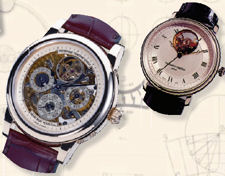
The 1980s was a very high-tech focused era for watches and remained so until the 1990s, when a resurgence of interest in mechanical watches materialized, paving the way for the Swiss watch industry to begin a comeback. Although the market soon saw high-tech watches fighting back, interest in mechanized watches has since remained stable and has even grown in the recent past.
FHS President Jean-Daniel Pasche explains that, following this crisis, “the industry recovered after a severe restructuring and the launching of new models, including quartz and mechanical watches, supported by marketing and communication campaigns.”
One company that moved to capitalize on this resurgence was Frèdèrique Constant, which developed its first “Heart Beat” watch in 1994. The purpose of the Heart Beat development, as the company explains, was to show that these Frèdèrique Constant watches were not quartz. Heart Beat watches have an aperture at the position of the balance wheel to show that the movement of the watch is mechanical. The mechanical watches introduced in the early 1990s looked similar to and could easily be mistaken for quartz watches, says Frèdèrique Constant, except that the second hand moved continuously, as opposed to the 60 steps per minute a quartz watch makes. Heart Beat watches were created with an open face to show this and distinguish these mechanical Swiss watches from non-mechanical watches, feasibly so that someone looking to buy a mechanical watch would be able to easily tell the difference between a Frèdèrique Constant watch and a quartz watch.
As to what makes Swiss watches different from all the others, FHS President Pasche proffers a clear-cut, no-nonsense answer. For him it’s about the legacy of the industry and what it does now to ensure high-quality and precision that distinguishes it. “The Swiss watch industry relies on 400 years of tradition and innovation,” he says.
“Moreover, our industry pays great attention to the education of people, in Switzerland and abroad. It is necessary,” he asserts, “to afford ski l led people,” an argument implying that Swiss watch brands invest more heavily in education than foreign ones. “
The brands are also continually searching for quality, efficiency, precision, as well as new technologies, new materials and new designs. A Swiss watch integrates all these characteristics.”
For all intents and purposes, the overall Swiss watch industry appears today to show very little sign of the veritable crisis that it got itself into.
For example, the Swatch Group, one of the largest manufacturers and distributors of Swiss watches, recently announced that the company’s 2007 net income exceeded CHF1 billion (CHF1.015 billion – $1.028 billion) for the first time in its history. Its 2007 gross sales were up 17.6 percent over 2006, to a record total of CHF5.941 billion ($5.4 billion), and it noted strong growth in all group divisions and maintained an “ongoing optimistic outlook” for 2008.
Swatch’s sales in its watches and jewelry categories, which made up the bulk of the company’s profit, grew a healthy 20.4 percent to CHF 4.71 billion ($4.28 billion). This sales increase, Swatch notes, was a result of “continued selective” expansion of retail activities, which has given the company’s brands strong visual presence in important retail locations. Concurrent with overall Swiss watch export figures, Asia, including the Middle East, posted notable double-digit sales growth, with Europe, America and Oceania also recording solid growth rates.
These numbers cover a period that saw a tough holiday season economically for American retailers – the U.S. is the largest market for this industry. In line with this, Swatch also noted that, “The difficult currency environment in the second half of the year, the continuing rise in the price of gold, platinum, diamonds and precious stones, as well as higher prices for almost all other raw materials, put a squeeze on margins.” In the context of this, the company said that “the strong trend of the 2007 financial year has been maintained in January and February 2008,” and a further increase in turnover together with enhanced profitability, despite the current negative impact of exchange rates, is anticipated.
But this is just one company. Sales and revenues for the entire Swiss watch industry are growing. Watch exports from Switzerland in December 2007 rose 13.8 percent by valve over December 2006 – to CHF1.433 billion ($1.434 billion), according to provisional year-end figures. “These very good monthly figures confirm what had been expected for many months: a record year and growth unrivaled over the last 18 years,” the Federation commented. For the year, watch exports totaled CHF15.96 billion, a growth of 16.2 percent over 2006.
Moreover, in 2006, Swiss watch exports by value are estimated to have made up almost half of total global watch exports ($11 billion of $25 billion total), and Swiss watch exports are growing faster than total world exports. In 2000, Switzerland exported watches with a total value of $6 billion, growing 25 percent to $7.5 billion in 2003 and a further 46 percent to $11 billion in 2006. This is contrasted with a $14 billion worldwide (non-Swiss) industry in 2000, which actually saw a 3.57 percent decline in the value of exports between 2000 and 2003, to $13.5 billion, and a 3.7 percent rise back to $14 billion in 2006.
Simply put, the Swiss watch industry has been on a steady path of growth since at least the beginning of the millennium, in contrast to the non-Swiss sector, the growth of which was non-existent.
Some of the fastest-growing markets for Swiss watches are the same as those for most retail items – including diamonds and jewelry (and non-Swiss watches) – the East. De Beers’ retail jewelry sector, which also sells a watch line, is opening stores left and right in Hong Kong, Macau and Beijing, just to name a few. Zenith, a Swiss company founded in 1865, opened its flagship boutique in Shanghai in January. The store includes an “innovative Watch Bar, [where] customers can enjoy both champagne and timepieces.”
While FHS figures indicate that the U.S. is the largest market by both volume and value for Swiss watches, Pasche confirms that the largest potential markets for the industry are in China, India and Russia.
 |
World distribution figures certainly support the trend. In 2007, the top three export destinations for Swiss timepieces were the U.S. (CHF2.440 billion ($2.441 billion)), Hong Kong (CHF2.433 billion ($2.434 billion)) and Japan (CHF1.207 billion ($1.208 billion)). Of the top 15 export destinations, one was in the Americas (U.S.), five were in Europe itself (Italy, France, Germany, the UK and Spain) and six were in the Far East (Hong Kong, Japan, Singapore, China, Taiwan and Thailand). Export percentage trends are also telling. Between 2004 and 2006, Swiss watch exports to the U.S. grew 24.46 percent, exports to other European countries grew 34.6 percent and, to East Asia, 27.23 percent.
Overall, exports of Swiss timepieces to Asia, including the Middle East, exceed those to any other area, including the Americas and Europe, in both units and value. Interestingly enough, although Africa, at the other end of the spectrum, receives the second lowest level of Swiss watch exports by both volume and value (lowest is Oceania), the growth rate, between December 2004 and December 2006 was the highest of every other category – at 54.5 percent.
Today, having successfully completed its restructuring, the watch industry in Switzerland is a vibrant part both of the country’s economy and the worldwide watch business. The Federation adds that, in the last five to seven years, it has secured the leading position among Switzerland’s most profitable industries in terms of export and production value. The industry has also diversified to produce tech watches alongside mechanical masterpieces. And, perhaps as a sign of its vibrancy, newer, very recently established brand names such as Daniel Roth and Hublot Geneve have gained some of the visibility that older and more recognizable names such as Rolex and Vacheron Constantin have enjoyed for a very long time.
The industry, post-restructuring, is also richer. In 1980, 860 companies generated CHF3.5 billion ($3.47 bi l lion) in value of exports, while in 2006, only 600 companies exported over four times that – CHF13.7 billion ($13.57 billion). However, Pasche admits that there are some real challenges to further growth – “Competition exists inside the watch sector but also from outside. People have many opportunities to spend their money (holidays, cars, travel, the stock market…) and it is not necessary any more to buy a watch to have time.“
Time is disclosed everywhere: mobile phones, cars, etc… Brands have to convince people to buy watches.” He also opines that brands must educate enough people to cover their needs in terms of skilled workers and in the development of new products and post-sales service, among other things.
Pasche is, however, optimistic. “The Swiss watch industry is still growing as there is potential for it; for instance, life standards are improving in the emerging markets, and the market for high-end watches is growing.”