
IDEX Online Research: Momentum Slows At Charles & Colvard
May 27, 08
Charles & Colvard reminds us of the children’s story, The Little Engine that Could, in which a steam railroad engine continues to chug ahead despite continuing adversity. Depending on the version of the story, though, the Little Engine was variously kept in service, retired or junked. Bob Thomas, chairman of Charles & Colvard, and his team are betting that the company has plenty of life and assuming it can weather the current slowdown in demand. They are expecting it to be ready to chug back along the rails, delivering moissanite jewelry to America’s retailers, sooner rather than later. For sure, Thomas has the energy and enthusiasm to make it happen, if the market cooperates.
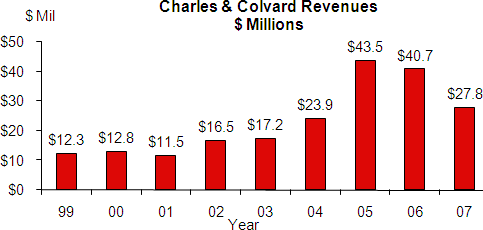
By jewelry industry standards, Charles & Colvard isn’t a large company. During its best year – 2005 – it posted revenues of just under $44 million. It is difficult to translate this into a consumer retail sales number, but our best guess is that it could be $150 to 200 million, depending on a variety of factors.
It has always been an uphill struggle for Charles & Colvard. When moissanite was first introduced, it was positioned as a substitute for diamonds, similar to cubic zirconium, glass, and other look alikes. Moissanite, a lab-grown crystal, has similar (or arguably better) characteristics versus a natural diamond.
The problem, though, with its initial market positioning was simple: 1) De Beers has spent so much money and so effectively communicated the value proposition of natural diamonds that anything other than the “real thing” just won’t do for most women and 2) no reputable jeweler wanted to carry a “fake” gemstone.
Near the beginning of the current decade, Charles & Colvard decided to reposition moissanite as a “stand-alone” jewel. It was making great progress, until the current recessionary environment came along. Because moissanite jewelry does not have a long-term track record, and because it is still only a tiny player in the $65 billion jewelry industry, it has been among the first product lines to be cut, as merchants have rationalized their retail offerings.
Sales Dropping
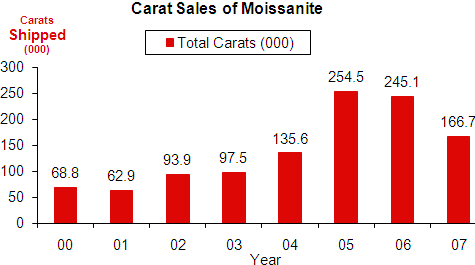
Like most jewelry suppliers, Charles & Colvard has experienced a decline in sales, with a sharp drop in 2007. The company cited four factors affecting sales last year, all of which are continuing into 2008:
- Retailers are not re-stocking, even when sales of moissanite are made.
- Retailers have made a commitment to cut back on inventory levels.
- Slower-than-expected sell-through at retail has hurt the company’s sales.
- The loss of a key customer who manufactured moissanite jewelry hurt demand.
The graphs below illustrate Charles & Colvard’s annual sales and carats of moissanite shipped during the current decade.
Source: Company Reports
Source: Company Reports
Profits Under Great Pressure
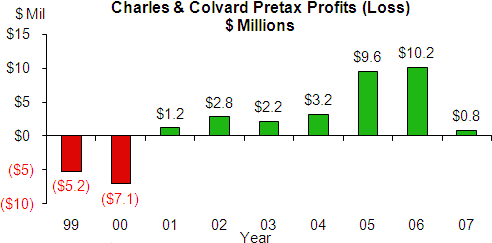
As Charles & Colvard’s revenues have sagged, its profits have diminished dramatically, as the graph below illustrates. As with most companies, profits are made on the margin. Thus, when revenues soften, profits decline dramatically. In 2007, corporate revenues were down about 32 percent, but pretax profits dropped by about 92 percent.
Source: Company Reports
Recent Results Disappointing
For the first quarter ended March 2008, Charles & Colvard reported that its net sales decreased 41 percent to $3.4 million as compared to $5.8 million in the first quarter of 2007. Its loss from operations was $1.1 million compared to operating income of $587,000 for the same period in 2007. The net after-tax loss was $698,000 compared to net income of $339,000 in the comparable period of 2007. The company shipped 18,400 carats of moissanite in the first quarter, down 48 percent from the prior year. The revenue per carat rose by 12 percent to an estimated $184/carat in the quarter ended March 2008, due to a greater mix of larger stones; that’s no surprise since customers are generally buying better, larger gemstones.
Drivers of Demand
While U.S. demand for moissanite was down in 2007 by 37 percent, international sales were up 7 percent, driven by demand mostly in new Asian markets. However, in the first quarter of 2008, sales were off both in the U.S. and international markets. In 2007, about 82 percent of the company’s sales were made to U.S. customers, a number that has been steadily declining (for example, it was 93 percent in 2005), as the company makes inroads into overseas markets.
Charles & Colvard has several key customers who fabricate moissanite jewelry for resale to retailers. The top four customers and their percentage of Charles & Colvard’s corporate revenues in 2007 are as follows:
- Reeves Park – 20 percent
- Samuel Aaron International – 19 percent
- Stuller – 14 percent
- K&G Creations – 11 percent – K&G has been dropped as of January 2008
At retail, Charles & Colvard has some very important customers, including the following (those with 50 or more stores carrying moissanite are listed in no particular order):
- J.C. Penney
- Finlay Enterprises
- Helzberg Jewelers
- Kohl’s
- Belk
- Army Air Force Exchange System (AAFES)
Unfortunately, two major retailers decided not to go forward with moissanite jewelry, after initially testing goods in their stores: Zale (Gordon’s and Peoples) and Sears. There are no new customers on the horizon in the domestic market, according to management.
Moissanite jewelry is currently bought mostly by women as a self-purchase item, though there has been an increase in gift sales. Consumer awareness of moissanite is around 10 percent in the U.S., up 200 basis points over the past two years. However, the company recently cited a study which suggests that awareness might be as high as 20 percent.
Charles & Colvard has some very persuasive arguments for jewelers who are considering adding moissanite to their product line-up, as follows:
- It will bring in a new customer base.
- Moissanite jewelry has a higher average ticket.
- It has “healthy” margins and can add substantially to profitability.
- It is a new incremental category for jewelers.
- If a retailer qualifies, Charles & Colvard is willing to put goods in the store on consignment, so there is limited inventory investment by the merchant.
What’s Next?
On Wall Street, the speculation is that Charles & Colvard is an acquisition target. Its stock is selling for just over $1 per share, with a book value of over $3 per share. Thus, even after a healthy write-down of assets, a potential buyer could still be left with value above the purchase price.
Assuming that Charles & Colvard Chairman Bob Thomas and his team – and a new slate of directors – can keep the company under their control, we believe that the company has a solid future. Management is doing all of the correct things, even if they may be a little late in implementing corrective actions:
- Nearly 20 percent of the company’s 65-member corporate staff were recently laid off. This is just one example of cost-cutting that has been implemented as a result of weak sales.
- Management has hired a consultant to make recommendations. The following areas have been addressed:
- Organizational structure
- Brand building
- Sales growth and marketing strategies
- Expense controls
- Inventory management
- Overall business model
-
- Management plans to split Bob Thomas’ job; he will remain chairman, but a new CEO will be brought in. In addition, new talent will be brought in for key top-level jobs.
- The company plans to aggressively pursue e-commerce sales of moissanite.
In the case of Charles & Colvard, the financials are promising; the company’s challenge is to convince retailers and consumers that moissanite is a highly desirable gemstone.