
IDEX Online Research: Household Income Is Most Important Predictor of Jewelry Expenditures
July 24, 08
It may sound crass to say that “it’s all about money,” but that is the key determinant to predicting who is most likely to buy jewelry: those consumers with high income levels spend disproportionately more on jewelry than consumers with lower incomes.
Based on the latest figures – data for 2006 from the U.S. government’s Bureau of Labor statistics, high-income consumers are the jeweler’s best friend.
Here’s what is different, though, in 2006: middle-income consumers spent more of their discretionary income on jewelry than in prior years, while high-income consumers spent slightly less on jewelry than in the past.
The graph below summarizes consumers’ jewelry expenditures in the U.S. market by income level.
|
|
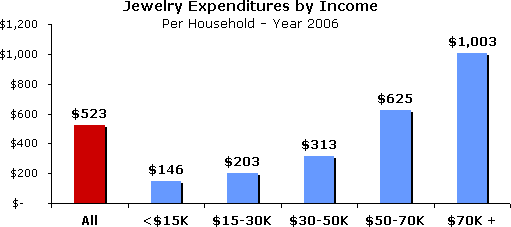
As the graph illustrates, the average U.S. household spent $523 on jewelry in 2006. At the lowest income levels, consumer households with less than $15,000 in reported income spent only $146 on jewelry, most of which was probably inexpensive fashion jewelry. Among the highest income consumers – those households with $70,000 or more in annual income – shoppers spent just over $1,000 annually on jewelry.
|
|
Jewelry Expenditures Smoother Across Income Levels in 2006
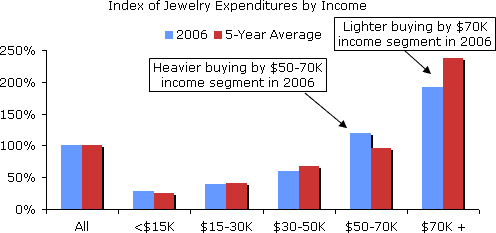
One of the changes that occurred in 2006 had to do with jewelry expenditures by income levels. While high income households clearly spend more on jewelry than lower income households, jewelry expenditures showed less variance by income levels in 2006 than in prior years.
The graph below illustrates jewelry expenditures by major income levels in 2006 versus the average of the past five years.
|
|
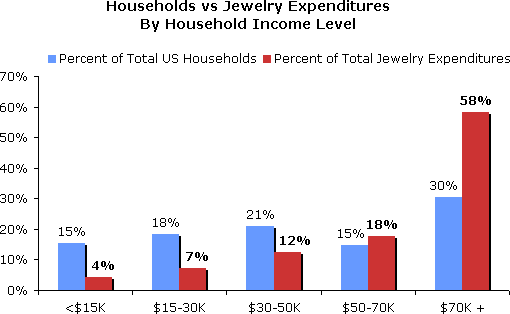
As the graph illustrates, consumers in the income bracket of $50,000-70,000 spent slightly more per household in 2006 than in the average of the five prior years, while consumers in the income range of $70,000 and above spent somewhat less in 2006.
High-Income Households Hold Most Potential
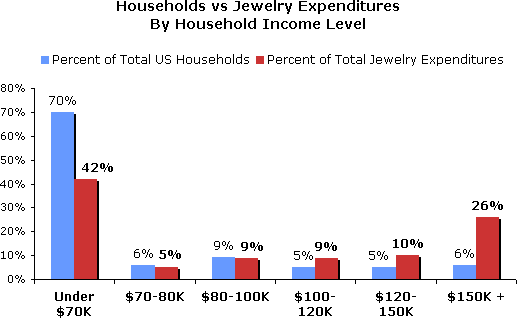
While jewelry expenditures by income range don’t exactly fit the proverbial 80/20 rule (it would suggest that 20 percent of all consumers make 80 percent of all jewelry expenditures), spending by high-income consumers isn’t all that far from the 80/20 rule. In fact, 30 percent of all U.S. high-income households – those with incomes over $70,000 annually – make almost 60 percent of all jewelry expenditures.
One of the problems confronting jewelers is how to reach higher income households that hold so much potential. The use of “mass media” advertising appears to be inefficient. That’s because more than half of U.S. households earn under $50,000 annually, and they account for a scant 23 percent of all jewelry expenditures. Again, it is the high income households that spend most heavily on jewelry.
The graph below summarizes the percentage of households by income level versus their aggregate annual expenditures for jewelry.
Highest-Income Households Spend Heavily on Jewelry
While the number of high-income households remains modest – roughly 30 percent of all U.S. households have incomes of $70,000 or greater per year, and just fewer than 20 percent of all households have incomes over $100,000 annually – the impact of the expenditures of these households is enormous. As a result, the
The graph below summarizes jewelry expenditures by households with annual incomes above $70,000 annually.
| |
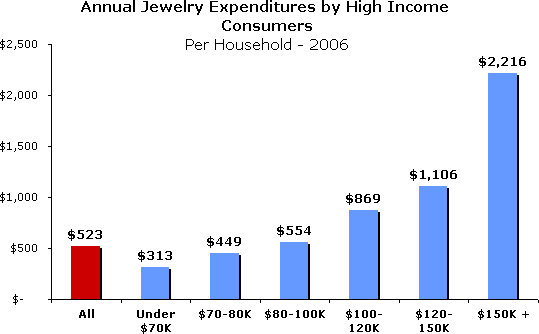
Once again, the highest income households hold the most potential for jewelers: the 6 percent of all U.S. households that earn $150,000 or greater annually are responsible for almost a quarter of all jewelry expenditures, as the following graph illustrates.
 Source: BLS |