
IDEX Online Research: Jewelry Price Inflation Higher At Retail
November 15, 10
(IDEX Online) - The wide disparity between retail jewelry price inflation and supplier price inflation that has characterized the jewelry industry for the past year appeared to moderate in August and September 2010.
After only very modest retail price inflation in May and June, followed by virtually no retail price inflation in July, the data for August and September have broken a year-long trend. September’s jewelry retail price inflation of +3.0 percent was moderately above the 1.8 percent average annual increase over the past two decades.
Several retail chain jewelers announced price increases during the first and second quarter of 2010, and more retail price increases were implemented early in the third quarter, in time to take effect in the 2010 holiday selling season. We now believe that independent retail jewelers have finally begun to raise their prices; hence, the Jewelry Consumer Price Index showed an increase year-to-year in August and September.
Jewelry Producer Price Inflation Continues to Rise Sharply
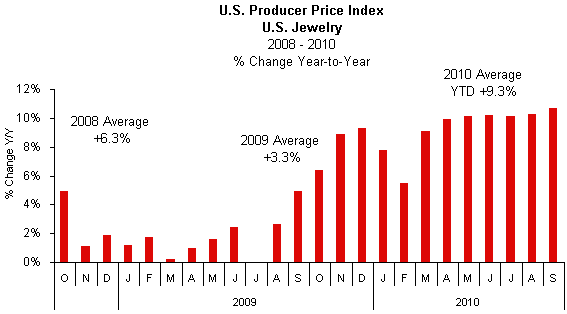
Producer prices for jewelry, as measured by the Jewelry Producer Price Index (JPPI), rose sharply in September by 10.7 percent, when compared to September 2009, driven primarily by higher prices of precious metals – mostly gold and platinum.
The Jewelry Producer Price Index has shown gains in the high single-digit range or low double-digit range for all of 2010 as well as the fourth quarter of 2009. Producer prices have risen at double-digit levels for the past seven months.
The graph below summarizes the Jewelry Producer Price Index – jewelry price inflation at the supplier level – for the past twenty-four months.
Source: BLS
While the Jewelry Producer Price Index averaged a very modest +3.3 percent inflation rate in 2009 during a recessionary environment when demand was soft, it has averaged 9.3 percent for the first eight months of 2010. (The BLS recently revised its data; these new figures are based on BLS revisions.)
In part, price increases have been implemented by suppliers who want to make up for their inability to raise prices in late 2008 and early 2009 when gold prices were soaring. Due to the recessionary environment in 2008 and 2009, suppliers could not pass along those higher gold prices to their customers.
JPPI Driven By Higher Precious Metals Costs
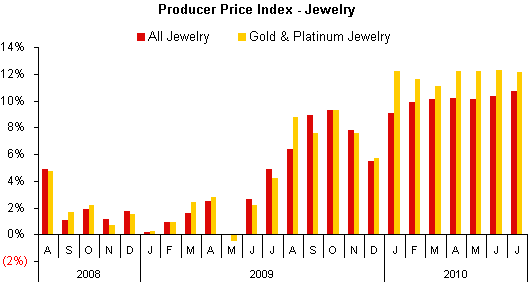
Precious metals prices have remained high for the past several months. These high prices have pushed supplier prices up, as the goods with high-priced metals have worked their way through the distribution pipeline toward retailers. The graph below compares the JPPI for all jewelry producer prices (red bars) to the JPPI for precious metal jewelry costs (yellow bars).
Source: BLS
Watch Producers’ Prices Rise Modestly
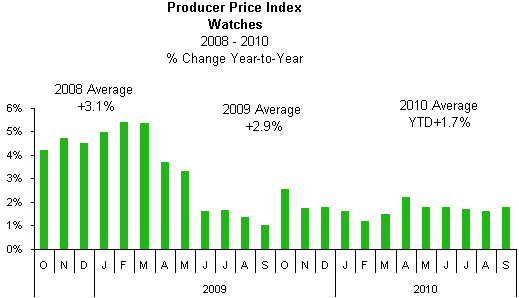
Producer price inflation for watches has held relatively steady in the 1.5-2.0 percent range for the past fourteen months or so, as the following graph illustrates. It has averaged 1.7 percent for the nine months year-to-date in 2010. However, these prices have not translated into higher retail prices for watches.
Source: BLS
Jewelry Consumer Price Inflation (JCPI) Moves Higher in September
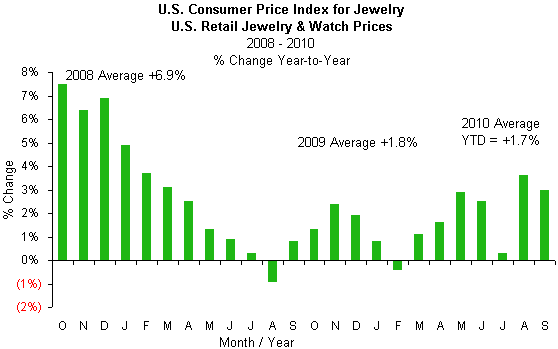
Retail prices of jewelry in September, as measured by the JCPI, were up 3.0 percent, the second largest gain since the first quarter of 2009. This is above its long-term two-decade trend of +1.8 percent annually.
After edging upward for the first six months of 2010, then slowing in July, the August and September spike in inflation caused the year-to-date JCPI to edge up to +1.7 percent. This year-to-date inflation rate for retail jewelry prices remains just below 2009’s average retail jewelry inflation rate of +1.8 percent; it also remains far below 2008’s inflation rate of 6.9 percent.
The graph below summarizes the JCPI for the past twenty-four months.
Source: BLS
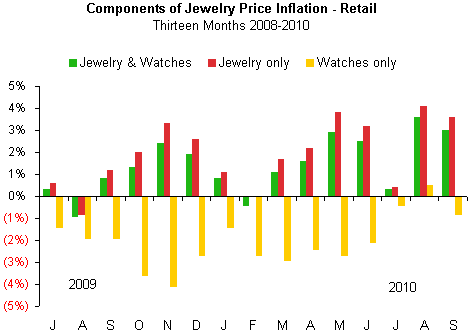
For the past year, the key components of the JCPI – jewelry (only) and watches (only) – showed a dramatic spread in their inflation rate. Watch prices fell sharply at retail, while jewelry prices are rose faster than the overall JCPI. Watch sales are about 11 percent of total jewelry industry sales, while jewelry of all types represents about 89 percent of total U.S. jewelry sales.
However, in August, retail prices of watches finally began to climb, after thirteen months of declining. But that trend reversed itself in September: watch prices fell by nearly 1 percent during the month, when compared to September 2009, a recessionary period when jewelers had no pricing power.
The graph below illustrates inflation among the key components of the JCPI. The green bars are total industry JCPI, while the red bars represent the inflation rate jewelry, and the gold bars represent the inflation rate for watches. Notice that the gold bar – watches – for August 2010 is in positive territory for the first time since June 2009, but fell back in September.
Source: BLS
The Disparity Between Producer and Consumer Jewelry Price Inflation
The disparity between inflation at the jewelry producer level and the jewelry retail store level is still large, but it may be abating. For the past year, higher wholesale prices have added stress to retailers’ and suppliers’ margins, which are already under pressure.
There is now plenty of solid evidence that shoppers are buying jewelry. August sales numbers were stronger than expected. The IDEX Online Research flash report for September jewelry sales is also encouraging.
While the economic recovery has been slow, growth is on the horizon. Along with growth comes inflation. The jewelry industry won’t be left out of the next round of inflationary pricing, in our opinion.