
IDEX Online Research: Jewelry Demand to Grow, Despite Changes in Consumer Savings & Debt Levels
January 20, 11
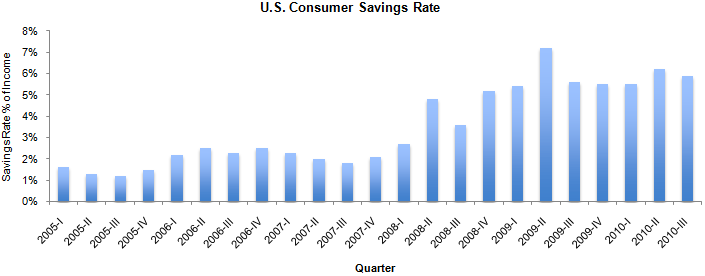
(IDEX Online) - Jewelers are worried about potentially unfavorable trends in consumers’ savings and debt accumulation habits. After saving no more than 1-2 percent of their income for many years, American households pushed their savings rate to as high as 7 percent in the recession of 2008-2009, and paid down their household debt by about 15 percent.
Both a reduction of debt and a boost to savings siphon off discretionary dollars that could be spent in jewelers’ stores.
Will American consumers continue to save more and take on less debt? Is this trend part of some kind of “new normal”?
Economists’ View: The Trend Is Positive
As an economist, we view both an increase in saving and a decrease in debt as favorable for the U.S. economy. Both actions reduce stress on the economy, and can fuel long term growth. But short term, they hurt immediate sales growth for merchants.
However, as a consumer behavior analyst, we know that neither of these trends will persist for long. Consumer behavior changes very slowly. Further, after peaking at about 7 percent in the recession, we are already seeing the savings rate decline to around 5 percent.
Further, we believe that the 2010 holiday selling season was driven, in part, by consumers who were willing to buy goods such as jewelry on credit. Thus, we expect to see an increase in consumers’ debt ratio sometime in early 2011.
Finally, based on history, we know that we can expect a reversion to pre-recession consumer spending trends, more or less, within the next year or two.
Consumer Balance Sheets Stronger
The recession of 2008-2009 was a wake-up call to American consumers. They had no financial cushion to fall back on, when paychecks shrank and jobs evaporated. As a result, they began to increase their savings and pay down debt.
Savings Rate Up
For years, the typical American family saved 1-2 percent of their income, a miniscule level compared to other geopolitical regions of the world. As soon as the recession hit, their savings rate soared, reaching a peak 7.2 percent in mid-2009, when the financial world looked like it might come to an end.
Since then, the personal savings rate has settled in at just over 5 percent, though it has been very slowly declining on a monthly basis. The savings rate has dropped to about 5.3 percent for November (the latest data) from 5.4 percent in October. In part, this is a seasonal trend; it part, it indicates that consumers are willing to cut back on savings as the result of an improving stock market and a bottoming housing market. In short, we expect that Americans’ savings rate will continue to slide, and could decline to low single-digit levels in a year or so.
The graph below illustrates Americans’ savings rate by quarter since 2005.
Source: BEA
Debt Levels Decline
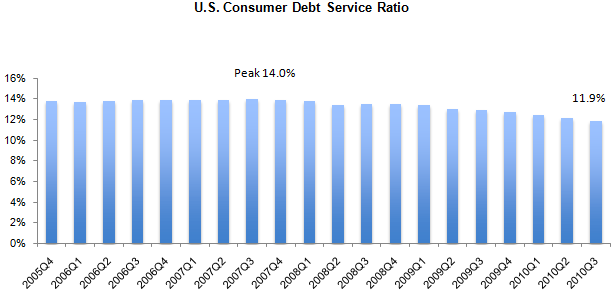
At the peak, Americans spent nearly 14 percent of their income on debt service – paying interest and principal on household debt, including mortgages and consumer loans.
The most recent reading on debt levels from the Federal Reserve indicates that American consumers have reduced their debt service payments to just 11.9 percent of household income, the lowest rate in more than a decade.
Consumer debt typically contracts somewhat in a recession, but usually begins to increase, once it is clear that economic growth is recovering.
In a recent Federal Reserve poll of Americans, about 15 percent of the respondents said it was OK to borrow to pay for luxury items, and half said that it was OK to borrow to cover living expenses. The survey also found that borrowing was significantly more acceptable in younger households.
The graph below illustrates consumer debt levels, including mortgage and household consumer debt, as a percentage of income.
Source: FRB
Bottom Line: Jewelers Sales Won’t Be Affected Meaningfully
Based on these two trends – a higher savings rate and lower debt levels – it would be easy to assume that American consumers are becoming fiscally more responsible. But that is likely to be an incorrect assumption.
While consumer debt levels have declined, it appears to consumers took on more debt in the recent holiday selling period. This trend, coupled with consumers’ attitudes that “debt is OK” suggest that it is likely that debt levels will begin to trend upward over the next year.
Jewelry has a 50,000 year history. Wars, recessions, plagues, and other disruptions have not affected consumers’ long term affinity for precious gemstones and metals.
We look for a return to pre-recession spending, savings, and debt levels – more or less – over the next year or two. That’s good news for jewelers.