
IDEX Online Research: Jewelers, Don’t Overlook the Importance of Lower Price Points
September 10, 09
Many retail jewelers and jewelry suppliers overlook the sales opportunity that merchandise at an accessible retail price point offers. Instead, they dream of selling that special $20,000 ring or some other exceptional piece of fine jewelry.
However, that’s not where the action is.
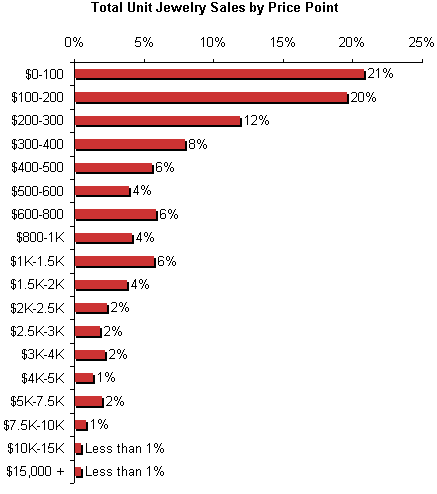
While the expensive jewelry creates the flash, excitement, and sizzle that brings shoppers into their stores, research has shown that about half of a specialty jeweler’s sales volume – measured in units – is bought by consumers at retail price points of $299 and below in the U.S. market.
Repeatedly, research confirms that most shoppers buy jewelry at accessible price points, rather than at very high price points. While the average ticket for a piece of diamond jewelry in the U.S. is about $800, most jewelry is sold at far lower retail price points. For example, the average retail price for a piece of gold jewelry is just over $78. It really hasn’t moved much over the past decade. Pearl jewelry – especially pearl earrings – is another category with a large number of items that jewelers offer for $100 or less at retail.
The Department of Commerce’s latest jewelry sales data confirms that the typical American jewelry consumer spends about $214 on jewelry during each shopping trip to a specialty jeweler during the year. Consumers are clearly conscious of price points, and they will spend only so much money. Thus, it is no surprise that half of all jewelry – measured in unit volume – is made at retail price points below $300.
The Importance of Accessible Retail Price Points for Jewelry
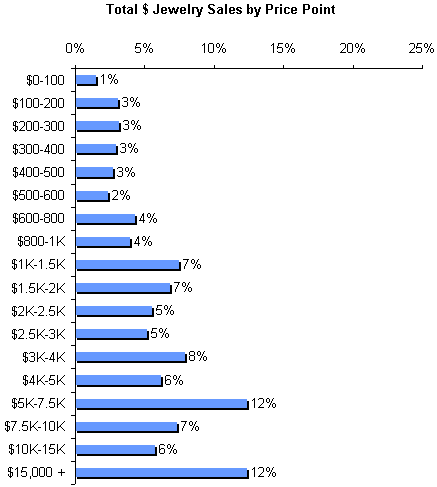
Why do most jewelers and suppliers over look low, accessible price points? While unit sales of jewelry below $300 retail represent about 50 percent of all jewelry sold, the aggregate sales dollars generated from merchandise in this price range are only about 7 percent of a specialty jeweler’s total revenues. Because lower-priced goods do not generate a large revenue stream, merchants often don’t realize just how important they really are.
But, here’s the importance of goods priced under $300: those sales generate a dramatic level of customer traffic – about half of a specialty jeweler’s customers spend that amount of money, when they shop for jewelry. The job of the retail jeweler is to train their sales people to boost the average ticket.
Average Ticket Doesn’t Tell the Whole Story
While the average ticket for a mass market jeweler such as Zale and Kay may be around $300-400, and the average ticket for a guild jeweler may be as high as $1,200, these figures are somewhat misleading. A mathematically calculated “average ticket” really doesn’t tell “where the sales action is.” For example, the average ticket for both mass market jewelers and guild jewelers is boosted by engagement ring sales, which generate an overall average ticket of just over $3,600 in the U.S. – and nearly $5,000 for specialty independent jewelers. Merchandise sold at these high retail price points distorts the average ticket calculation, and it obscures the unit sales volume at lower price points.
It is far more informative to analyze a jeweler’s sales by price point, rather than by a simple mathematical average ticket.
When a typical specialty jeweler’s sales are analyzed by price point, it appears that there are at least three “pockets of demand” where sales are especially strong, rather than a single “average ticket” value. While the average ticket is $1,200 for a guild jeweler, roughly half of their sales are made at retail price points below $300. Further, there is especially strong demand for jewelry in the $600-800 retail price range, and another “pocket of demand” at retail price points between $1,000 and $1,500 for specialty jewelers.
It is extremely important for jewelers to understand and analyze their unit sales rate by price point. For example, jewelers who simply order the same amount of merchandise for each retail price point are missing out on sales at the so-called “hot” price points: under $300; $600-800; and $1,000-1,500. They will run out of merchandise at those key price points because they didn’t order enough goods. Worse, because they run out of merchandise, the importance of demand at those price points will be obscured. A mathematical calculation of the average ticket doesn’t reveal a specialty jeweler’s unit sales rate by price point, a critical piece of information for buying and inventory control.
Tiffany & Co. does not report its average ticket, though reports peg it just over $400. Obviously, that number is meaningless, because Tiffany sells goods ranging in price from less than $100 to $50,000 and above. Tiffany now provides more meaningful figures in its legal filings:
- Its average retail price for gemstone jewelry and gemstone band rings, other than engagement jewelry, was $3,300 in 2008; this category represented 26 percent of sales in the Americas.
- Its average retail price of diamond rings and wedding bands (mostly platinum) was $3,000 in 2008; this represented 15 percent of sales in the Americas.
- Its average retail price for non-gemstone precious metal jewelry in 2008 was $700; this was 10 percent of sales in the Americas.
- Finally, its average retail price for sterling silver jewelry – a favorite of tourists – was about $200 in 2008. This represented 34 percent of its total sales revenue in the Americas, a number that has been rising.
The four jewelry categories above represent about 85 percent of Tiffany’s sales of just under $1.6 billion in the Americas. The balance of 15 percent of its revenues in the region are sales of timepieces; sterling silver goods such as flatware, cups, and bowls; trophies; key holders; picture frames and desk accessories; crystal, china, and other tableware; and a variety of other products.
Here’s what is important from these numbers: based on an analysis of the jewelry portion of Tiffany’s sales, a whopping 86 percent of its total unit volume is sold at a retail price point below $300. That clearly drives home the importance of having adequate jewelry merchandise at retail price points below $300.
The following graph illustrates unit sales volume by price point for the typical specialty independent jeweler in the U.S. market. It shows that roughly half of all jewelry sales – by unit volume – are made at a retail price under $300.
Source: IDEX Online Research
While unit sales at retail price points under $300 represent about 50 percent of a jeweler’s volume, total sales as measured in dollars at that level are just over 7 percent of aggregate revenues for the typical independent specialty jeweler, as the graph below illustrates.
Source: IDEX Online Research
The Lesson for Jewelers
While it is important to display high-end dazzling jewelry, it is extremely important to have lower priced goods – generally at accessible retail price points of $299 retail and under – to create the perception of value, in order to build a broad, solid customer base. Once a loyal base of customers exists, jewelers who train their sales people how to boost the average ticket will build a business that will sustain them through any economic cycle.