
IDEX Online Research: Searching for New Markets, The Process Continues
October 17, 07
Diamantaires and jewelry suppliers are always looking for the next undiscovered hot market for their jewelry. While America continues it reign as the world’s largest jewelry market – by value, it accounts for about 50 percent of all diamonds and jewelry sold globally – and its growth is predicted to remain robust for at least the next decade or more, the U.S. is a hotly competitive market, both at the supplier level and among retailers of jewelry.
Wouldn’t it be nice to sell jewelry into a market – some out-of-the-way place loaded with wealthy shoppers – that has been overlooked by most others in the industry?
Unfortunately, in a world of instant electronic communications, there aren’t many secrets. And that’s the short story about where the next hot market for jewelry will be. Everyone thinks they already have the answer.
Perhaps.
Clearing the Fog
Recently, the Population Reference Bureau (PRB), an organization that analyzes complex demographic information, published its annual World Population Data Sheet. The name underplays this data. it is far more than simply population trends.
Want to know births and deaths per 1,000 population of each country in the world? It’s there. Want to know the life expectancy of someone living in the UAE? It’s there. Want to know the carbon dioxide emissions per capita in Mongolia? It’s there.
Even more important, the PRB data sheet projects global population by country (as well as some other statistics) for the years 2025 and 2050. So, if you operate a family-owned business, you can see where the market will likely move when you children and grandchildren are running your business.
In an effort to help jewelers and diamantaires find the next hot market, we’ve taken some base data from PRB’s new database, and we’ve crunched the numbers to see if there is an undiscovered market for jewelers. The quick answer: probably not. On the other hand, there are some up-and-coming markets that jewelers with a long term view should keep on their radar.
There are two filters that determine how viable a market may be to jewelers:
- How large is the population?
- How much money do consumers have?
Fortunately, the new PRB database answers both of these questions, and provides additional filters for jewelers who might be enticed by some of the results. For example, why aren’t Canada and Australia, both countries with high personal income levels, great jewelry markets? The quick answer is this: the population density is one of the lowest in the world, with only three people per square kilometer. You simply can’t efficiently reach such a low population density with a low-cost marketing strategy. by comparison, the world’s population density is 49 people per kilometer; the U.S. has 31 people per square kilometer and the U.K. has 251 people per square kilometer.
China: Move Over, India’s on the Way
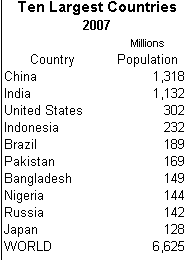
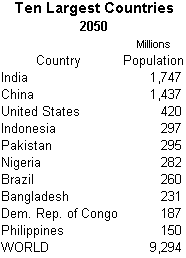
China may be the largest country today with 1.3 billion people, but by 2050, PRB’s demographers are projecting that India will far surpass China’s population. The tables below illustrate the world’s ten largest countries today and in 2050.
Source: PRB
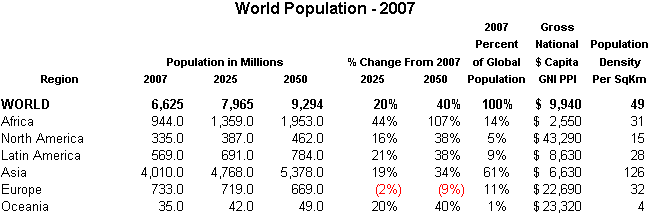
What will the population distribution be in 2050? Africa’s population will double; Europe’s population will decline by 9 percent. Every other region is expected to grow roughly in line with global population of around 40 percent.
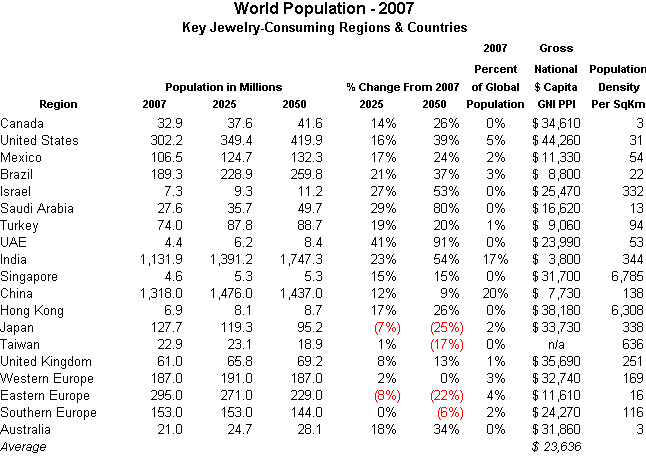
By country, PRB’s demographers have become more bullish on China’s population. Since the government no longer strictly enforces the one-child-per-family policy, China’s population is forecasted to grow by 9 percent between now and 2050; prior forecasts called for a shrinking population in China. However, its neighbor Japan is not so lucky: the Japanese population is predicted to contract by 25 percent over the next several decades. Taiwan’s population is also expected to decline by 17 percent. In addition, Eastern and Southern European countries will lose population.
Source: PRB
The Old Refrain: It’s All About Money
Today, the world’s best jewelry markets also have among the highest income levels per capita. The PRB uses a measure called GNI PPP, a moniker that only a demographer could love (or decipher). GNI PPP per capita is Gross National Income in Purchasing Power Parity divided by population. Purchasing Power Parity converts each country’s currency into U.S. dollars and indicates the amount of goods and services that one could buy in the U.S. with a given amount of money. GNI PPP levels the playing field, when it comes to comparing income levels (and perhaps buying power) of consumers in any country in the world.
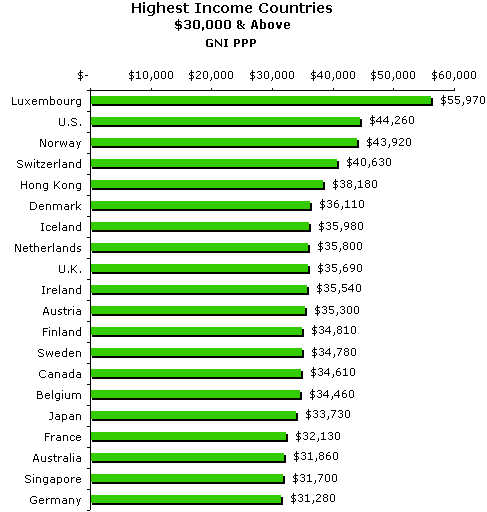
In short, world’s best jewelry markets are comprised of consumers with the most money. In the best jewelry markets, the typical GNI per capita is $23,600. In the U.S., the GNI per capita is almost $44,300; that’s the second highest in the world. Both income levels are far above the global $9,940.
Who has the highest GNI per capita? Luxembourg’s GNI per capita is a whopping $55,970; its roughly half a million inhabitants must live well.
The table below summarizes the findings from PRB’s most recent Population Data Sheet for the seven major global regions. Full detailed information can be found at prb.org online.
Source: PRB
Diamond & Jewelry Consuming Regions Have High Incomes
The table below summarizes PRB’s population data for countries which are major diamond and jewelry consuming markets. With only a couple of exceptions, these countries have very high income levels, as measured by gross national income (on a purchasing power parity basis) per capita.
Source: PRB
High Income Countries Generally in Asia, North America & Western Europe
Abraham Maslow’s Hierarchy of Needs tells us that people use their money first for food, clothing, and shelter. At some level, after their basic needs are met, they will spend money on discretionary items such as jewelry. Thus, jewelers have rightfully targeted high income markets first.
The graph below illustrates the global markets with the highest income levels per capita in the world.
 Source: PRB |
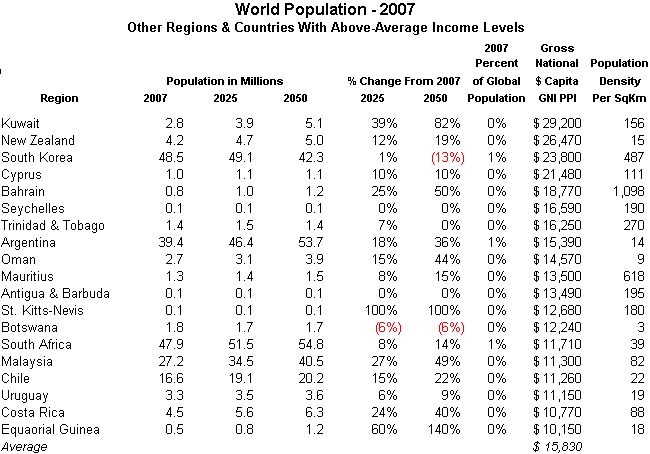
In addition to these richest countries, there are also many countries which have “above average” levels of income, including those listed on the following table.
Unfortunately, with only a couple of exceptions, most of these countries are too small to be of major importance to global jewelry marketers.
Source: PRB
Large Populations Usually Don’t Have Enough Resources
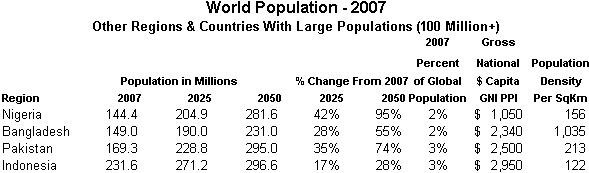
Some of the countries and regions with the largest populations simply don’t have the resources to support those populations, and consumers in those areas are often among the poorest in the world. However, there is often some income inequity, and there may be some very wealthy jewelry shoppers who could be targeted by jewelry suppliers.
The table below summarizes a few of the largest – but poorest – nations.
Source: PRB
The Final Analysis: Follow the Money
Virtually every research project confirms that consumers with high levels of discretionary income are the best jewelry shoppers. Thus, there are two ways to target those consumers:
- Market goods in a country with overall high levels of personal income – These would be countries in Western Europe, North America, and selected Asian nations.
Market goods into countries where there is a high level of income inequality. PRB identifies such countries as China, Mexico, Bolivia, and Zambia. India also has income inequality, but it isn’t as severe as some other countries. Target high income consumers in those countries, and you may be successful, despite generally low levels of GNI PPP.