
IDEX Online Research: Christmas Jewelry Sales: Sorting Through the Numbers
January 26, 09
If there was any doubt about whether Santa would actually deliver the proverbial ashes, switches, and a lump of coal, we need to look no further than jewelry sales in the U.S. market during the 2008 holiday selling season. While final industry numbers aren’t in yet, the publicly held jewelers have reported their numbers and they were awful.
And the worst part: the jewelry industry didn’t do anything to antagonize Santa – no one was the “bad little boy” who provoked Santa to bring a nearly empty sack of treats.
In recent times (reliable monthly sales numbers for specialty jewelers go back only a couple of decades), the worst November-December holiday selling period for jewelry occurred in 2001, when sales were down 6 percent. Preliminary numbers for November show that specialty jewelers’ sales in the U.S. market declined by 16 percent; most forecasters expect December to be slightly worse.
Here’s what some executives from the publicly held jewelry companies said about the 2008 holiday selling season:
- Terry Burman, group chief executive of Signet group (Sterling Jewelers in the U.S.): “. . . the U.S. [had] the toughest market conditions that I have ever experienced.” However, there was a ray of light: profits. After commenting on the company’s 250-basis point improvement in its gross margin, Burman said, “Profits for the full year are expected to be within the range of market forecasts despite an extremely challenging environment.”
- Neal Goldberg, CEO of Zale Corporation: “This holiday period was the most difficult in memory due to the overall macroeconomic situation.”
- Michael Kowalski, chairman and CEO of Tiffany & Co.: “Deteriorating global economic conditions were clearly reflected in cautious spending by Tiffany customers across the entire range of jewelry categories and price points.”
- Thomas Andruskevich, president and CEO of Birks & Mayors: “This year’s holiday season has proven to be extremely difficult given the challenging retail environment, especially for the luxury and jewelry sectors.”
- Art Reiner, chairman & CEO of Finlay Enterprises: Reiner was uncharacteristically quiet, and had no quote in the company’s press release. This is the second time in a couple of months that Reiner has been unusually quiet in a press release.
The graph below summarizes sales results for the publicly held jewelers during the November-December 2008 holiday selling season.
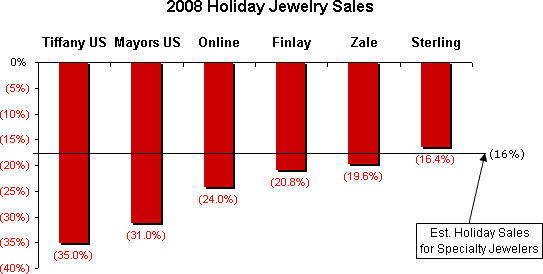
Source: Company Reports
Highlights of the 2008 holiday selling season included the following:
- The 2008 holiday selling season was by far the worst sales period in recent history. Sales are estimated to be down about 16 percent for specialty jewelers in the two-month period. The next worst period was 2001, when sales declined by 6 percent.
- Upper-end jewelers such as Tiffany and Birks & Mayors posted weaker sales than mass market jewelers, as the graph above illustrates. Further, sales at Sterling’s higher-end Jared stores were weaker than at its mass market Kay stores. Shoppers traded down; this often happens in a recessionary period.
- The average ticket declined, often significantly, for jewelers.
- Many jewelers reported that the number of transactions fell, but a surprising number of jewelers noted that their number of transactions increased slightly.
- Jewelry selling at the highest price points experienced the weakest demand; lower ticket jewelry – especially silver and inexpensive gold jewelry – was less weak.
- Jewelers reported significantly fewer big-ticket sales. Jewelers’ “best” customers spent considerably less during the 2008 holiday selling season. For example, one jeweler who made six sales of $50,000 or more in 2007 had only one sale at that level in the 2008 holiday selling season.
- Customer traffic was generally weak, especially in the malls. Strip center traffic was also weaker than expected.
- Demand for larger diamond engagement solitaires was weaker than expected, though Tiffany reported that it was one of its better-selling categories. Overall, bridal demand remained more or less on trend, though customers were spending less.
- Less than 10 percent of all jewelers reported a sales increase during the 2008 holiday selling season, based on our sample of jewelers’ sales reports. IDEX Online maintains a sample base of U.S. jewelers who help confirm the government numbers.
- Jewelry and watches were one of the worst performing categories for online merchants.
- The repair business appeared to remain solid. While this is only about 11 percent of a typical jeweler’s business, according to the Jewelers of America Cost of Doing Business Survey, it is usually one of the most profitable categories for jewelers.
- Most chain jewelers reported that December sales were much weaker than November sales. Both Zale and Sterling said that December was notably weaker than November, but Tiffany reported that its December sales improved slightly.
- In the immediate post-Christmas selling period, sales strengthened for most jewelers.
- Despite tough conditions, jewelers who held the line on pricing were rewarded with a higher gross margin. Sterling Jewelers reported that its gross margin will be up 250 basis points, and that its full year operating margin will be about 7 percent, somewhat above the industry average of about 5-6 percent or so.
- Most jewelers are over-inventoried in the post-holiday season. This means that suppliers should expect a much lower level of re-orders.
Company specific comments include the following:
Sterling Jewelers
- U.S. same-store sales for Sterling Jewelers fell by 16.4 percent in the 2008 holiday selling period. Total sales declined by 14.0 percent.
- Kay reported that December sales were far softer than November. Around the Thanksgiving period, management said that same-store sales were running at an 11 percent decline from the prior year. We estimate that December same-store sales were down in the high-teen range.
- Jared sales were weaker than Kay sales. Management said they saw weaker demand among their upper end consumer base who typically shops at Jared.
- Sterling’s average ticket fell by 8 percent in the November-December period. In the nine months preceding (February through October 2008) the holiday selling season, its average ticket had been running 7 percent ahead of the prior year.
- Management noted that consumers traded down, rather than turning away from jewelry. Signet CEO Terry Burman said, “Our basic experience and knowledge in the industry tells us that [jewelry] is a very inelastic category.” In other words, while consumers are shopping for value, a lower price won’t necessarily make them buy more jewelry, nor will a lower price entice shoppers to buy jewelry if they had planned to buy something else. That’s how Sterling generated an increase in its gross margin – it didn’t give the goods away to get sales. As proof that this strategy was successful, Sterling’s sales were about in line with the industry average decline.
- Sterling noted that the overall jewelry industry was especially promotional due to a large number of bankruptcy sales as well as clearance sales by merchants moving goods at any price to generate cash flow. However, despite heavy price-based promotions, jewelry retail price inflation in the November-December period was +6.7 percent in the U.S. market, according to government statistics.
- Sterling reported that its name designer jewelry sold well. Specifically, management mentioned that the exclusive Jane Seymour range was successful, and the LeVian collection performed strongly in both the mall brands and Jared. The proprietary Leo diamond brand outperformed other categories, and the bridal category held up better than average.
- Sterling’s mix of credit sales was about average – and just under 50 percent of sales – for the holiday selling period. For the full year, credit sales will be about 53.1 percent of total sales; jewelers’ credit sales mix is normally lower during the holiday selling season.
- Sterling’s approval rate for credit sales was down a dramatic 420 basis points in the holiday selling season. Sterling, which administers its own credit, clearly did not use credit to unduly drive sales.
- Sterling does not expect to raise retail prices in 2009; it adjusted prices – generally upward – in 2008, and those prices should hold this year.
- Despite weak holiday sales, Signet Group (U.K. and U.S.) expects to post a 7 percent operating margin, which is above the U.S. jewelry industry average.
Zale Corporation
- Same-store sales for Zale (all brands) declined by 19.6 percent in the 2008 holiday selling period. Total revenues fell by 19.5 percent. Management did not disclose same-store sales trends by brand.
- November same-store sales fell by 13 percent and December same-store sales fell by 22 percent.
- November sales were boosted by improvement in demand during the Thanksgiving weekend.
- December sales improved during the week leading up to Christmas.
- The post-Christmas sales trend “has been good,” according to management.
- At the end of December, Zale’s inventory levels were $115 million below the prior year. That is an estimated 13 percent decline; the number of Zale doors dropped by about 6 percent in the same period. Thus, same-store inventory levels were down by an estimated mid-single digit level.
Finlay Enterprises
- Finlay’s same-store sales from continuing operations fell by 20.8 percent in the 2008 holiday selling period. Including discontinued operations – certain Macy’s units and Lord & Taylor – Finlay’s same store sales fell by 20.1 percent. Total sales declined by 23.7 percent.
- Specialty jewelry stores, consisting of Carlyle, Congress, and Bailey Banks & Biddle (which was acquired in November 2007), contributed sales of $88.1 million for the two-month period ended December 2008, versus $130.2 million in the 2007 holiday selling period, a decline of 32 percent. It is important to note that Bailey Banks & Biddle was acquired on November 7, 2007. Thus, in 2007, it contributed one week less of sales to Finlay than it did in 2008. In short, it appears that Finlay’s specialty jewelry division experienced an apples-to-apples sales decline near 35 percent for the holiday period. Its specialty jewelry stores are higher-end, with a much higher average ticket that its department store units which feature largely fashion jewelry.
Birks & Mayors
- Same-store sales in Birks & Mayors’ U.S. division were down 31 percent in the 2008 holiday sales period.
- Same-store sales for Birks & Mayors in Canada declined by 19 percent in the two-month November-December 2008 period.
- Total sales for Birks & Mayors stores in both the Canadian and American markets in the 2008 holiday selling period decreased by 31 percent, on a reported basis. On a constant currency basis, total sales declined by a more moderate 23 percent.
- Birks & Mayors noted that its average ticket declined notably in the U.S. The U.S. Mayors stores specialize in sales of upper-end watches such as Rolex. Most jewelers reported that Rolex demand was quite weak.
Tiffany & Company
- Same-store sales in Tiffany’s U.S. stores fell by 35 percent in the 2008 holiday selling period.
- On a constant currency basis, worldwide net sales declined by 20 percent and worldwide same-store sales dropped by 24 percent.
- In the “Americas” region, which includes essentially all stores in the western hemisphere, total sales were 30 percent lower than the prior year’s holiday selling season. While the company did not provide specific numbers for markets other than the U.S., it gave directional trends: Canadian sales were up double-digit; sales in Brazil were up, and sales in Mexico were up slightly.
- In the U.S. market, same-store sales were down by 39 percent in November, and dropped by 33 percent in December.
- On a geographic basis, virtually all regions of the U.S. were weak.
- The New York Fifth Avenue Flagship store posted a sales decline of 35 percent for the two-month period. November sales were down 41 percent, and December sales were down 32 percent.
- Same-store sales in the nine units in the New York region were down 35 percent.
- Same-store sales in all U.S. branch stores were down 35 percent. November sales were down 38 percent, while December sales were down 34 percent.
- About two-thirds of Tiffany’s sales decline was due to fewer transactions. The balance of the sales decline was due to a lower average ticket.
- Sales were down for every price strata. Sales of merchandise priced under $500 at retail declined by the least amount.
- Sales to domestic U.S. customers and overseas customers fell by about the same amount. In part, this is due to a stronger U.S. dollar late in the year which made dollar-denominated goods more expensive to overseas customers. .
- Tiffany’s online and catalog division posted a 21 percent sales decline due almost entirely to fewer orders.
- Tiffany’s Iridesse pearl stores posted disappointing sales levels. Management did not give out specific numbers.
- By merchandise category, management highlighted the strong, the weak, and the average:
- Weakest demand: high-end statement jewelry and fine jewelry collections.
- Stronger-than-average demand: engagement jewelry, fashion jewelry, and silver & gold charms.
- Average demand: name designer jewelry.
- The company plans to offer early retirement to about 800 people. In addition, layoffs are planned.
- The company’s new store expansion program will slow in 2009 to a gain of about 5-6 percent new store space.
- In other non-U.S. markets, sales were mixed. All results are reported using constant exchange rates.
- Tiffany posted a same-store sales decline of 3 percent in Europe. In the U.K., same-store sales dropped by 10 percent. Sales in Italy and Germany were up
- In the Asia-Pacific market, same-store sales dropped by 13 percent. In Japan, same-store sales were down 15 percent. Other markets in the Asia-Pacific region posted a same-store sales decline of 9 percent. Hong Kong sales were down.
- Three markets posted notably stronger sales: China, Australia and Korea.
J.C. Penney
- J.C. Penney reported that jewelry was one of its weakest product categories. Overall same-store sales declined by 8.1 percent for J.C. Penney. Thus, we estimate that jewelry sales fell by double-digit levels.