
IDEX Online Research: Jewelry Price Inflation Continues to Moderate
May 25, 09
Since the beginning of the year, there has been virtually no inflation at the jewelry producer level, as measured by the Jewelry Producer Price Inflation Index. As a result, price inflation at the retail level, as measured by the Jewelry Consumer Price Inflation, has continued to diminish.
There are several reasons that jewelry price inflation has moderated, both at the retail level as well as at the producer level further up the pipeline:
- Demand for jewelry at the consumer level remains weak. Most specialty jewelers are reporting that sales are running at about 85 percent of last year’s levels. At this rate, they are not replenishing stock, except for the fastest selling pieces.
- No supplier, especially at the supplier and wholesale level, has pricing power. Even at the diamond mining level, where there are only a few suppliers, prices are moving up and down, affected by buyers demand rather than by some artificial vehicle.
- In early 2008, many retail specialty jewelers raised their prices to reflect much higher commodities prices. Precious metal and diamond prices surged in 2007 and early 2008, forcing all players in the pipeline to raise prices.
While there has been some stabilizing – and modest rising – of commodities prices in recent months, they have not begun to increase as many forecasters’ models predict, assuming they follow the historical model of moving upward on expectations of an economic recovery. However, we believe it will be only a matter of time – a short time – before commodities prices begin to rise notably, especially as it becomes clear that the current recessionary environment is abating.
Jewelry Price Inflation: April 2009
Here’s the summary of inflation at the jewelry retail and supplier level for the month of April 2009, as expressed as a percentage change year-over-year (April 2009 versus April 2008) in the U.S. market:
- Jewelry Producer Price Index +0.8 percent
- Platinum & Gold Used in Jewelry +0.7 percent
- Other Precious Metals Used in Jewelry +4.0 percent*
- Jewelry & Watch Consumer Price Index +2.5 percent
- Jewelry CPI +2.6 percent
- Watch CPI +1.5 percent
* New this month
The Bureau of Labor Statistics recently developed a new sub-category for Jewelry Producer Price Index – “Other Precious Metals Used in Jewelry.” In the past, these metals were included in the “Platinum & Gold” category. We have asked the BLS to provide us a full description of the metals that they include, and this was their answer: “Jewelry made of silver; jewelry made of other metals, but clad or plated in gold, silver, or platinum; jewelry made of precious or semi-precious stones; and other miscellaneous jewelry products made from precious metals such as cuff links and money clips.” April’s inflation rate of 4.0 percent for this “other” precious metals category suggests that there may be a sampling aberration that should be corrected, since there has been no corresponding rise in commodity prices to justify this kind of producer price inflation, in our opinion.
At the retail level, inflation continues to diminish, as predicted, primarily because we are nearing the anniversary date of last year’s price increases that jewelers implemented in the second quarter of 2008. Comparisons in the first few months of 2009 versus the same period in 2008 reflect “old pricing” in 2008 versus “new higher prices” in 2009. In subsequent months in 2009, retail prices will be compared to the higher prices that were implemented in the second quarter of 2008. Since there have been no material retail price increases since mid-2008, inflation at the retail level in the U.S. market should remain modest. Even when demand recovers, we don’t look for any significant retail price increases until perhaps 2010. Merchants are going to be cautious before they implement new higher prices which might scare off their loyal customers.
Jewelry Producer Price Index (JPPI) +0.8 percent in April
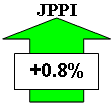 |
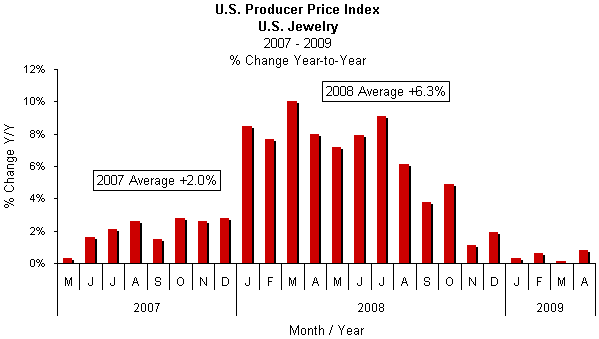
The April JPPI was far below the Jewelry Producer Price Index for 2008, which topped out at +6.3 percent for the full year. The 0.8 percent gain in April is just above the annual inflation rate – which averaged about 0.7 percent – that characterized the jewelry producer industry in 2000 through 2002, a recessionary period. It primarily reflects relatively stable precious metals prices. Further, April’s inflation rate is well below the long term Jewelry Producer Price Index increase of about 1.4-1.5 percent annually.
The following graph summarizes the monthly Jewelry Producer Price Index for inflation since early 2007. The percentage figures are based on year-to-year comparisons of the BLS Jewelry Producer Price Index (April 2009 versus April 2008).
Source: BLS
Jewelry prices at the supplier level – as measured by the Jewelry Producer Price Index – remain very low for a multiplicity of reasons, including the following:
- Retail jewelers have cut back on re-ordering merchandise. Thus, with no solid demand, the highly fragmented pipeline of suppliers have no pricing power.
- There is still a relatively large backlog of goods in the distribution pipeline that suppliers are willing to sell at almost any price, in an effort to raise cash.
- Retail jewelers simply won’t accept higher prices in the current recessionary environment.
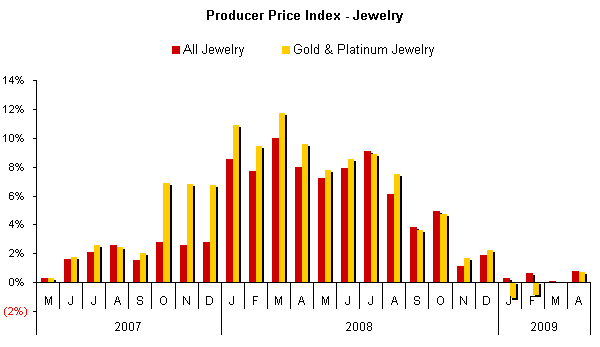
Prices for both precious metal jewelry and gemstone jewelry have moderated. The graph below compares the JPPI (red bars) to inflation for precious metals (gold bars); gold had been the primary driver of precious metals inflation in 2007 and most of 2008. In January 2009, gold prices pulled back modestly, but have risen modestly recently. In our opinion, $900-$1,000 gold has been priced into goods produced by jewelry manufacturers, and therefore producer prices aren’t likely to rise notably from current levels.
As the graph below illustrates, prices for precious metals used in jewelry at the supplier (producer) level are showing miniscule inflation.
Source: BLS
Jewelry Consumer Price Index (JCPI) +2.5 percent in April
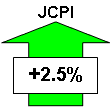 |
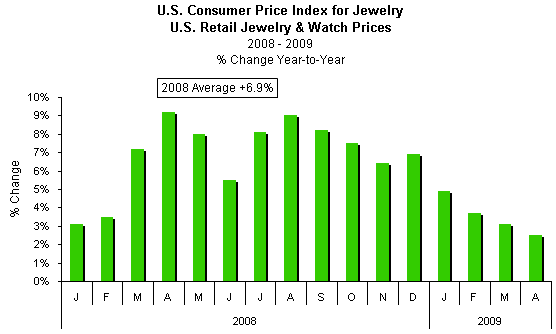
U.S. jewelry consumer prices (JCPI) rose by 2.5 percent in April 2009, as calculated by the BLS. After rising sharply through the second quarter of 2008, jewelry price increases at the retail level moderated in the late summer of last year, a continuing trend due primarily to the current recessionary environment.
For the full year 2008, retail price inflation for jewelry in the U.S. market ran at an annual rate of +6.9 percent. Now, however, it is clear that jewelry price inflation is moderating, and it will likely remain lower than 2008 in the coming months, especially as we reach the anniversary of last year’s price increases that jewelers implemented in the second quarter of 2008.
Further, we note that jewelry price inflation at the retail level is still running well ahead of its two-decade annual gain of about +1.6 percent.
The graph below summarizes the percentage change in retail prices of jewelry and watches by month on a year-to-year basis since the beginning of 2008. The percentage change is based on a comparison to the same month a year ago (April 2009 versus April 2008).
 Source: BLS |
Watch Price Inflation Tumbles
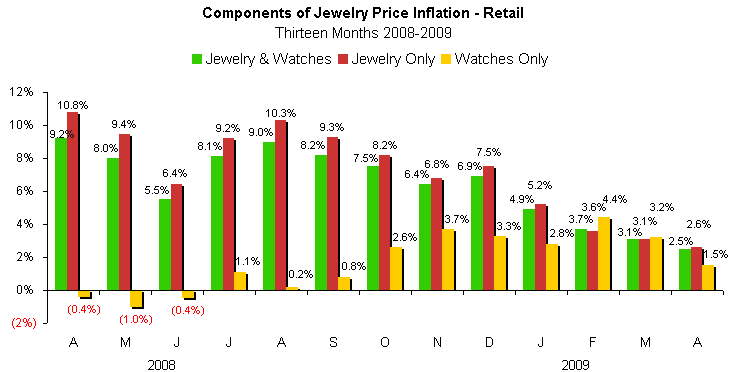
Early in 2008, the components of jewelry and watch price inflation at the retail level reflected a disparity in price increases. Jewelry retail prices were up consistently during the first half of 2008, but watch retail prices showed virtually no price inflation. In the past few months, watch price inflation has steadily increased, though it moderated in January, picked up again in February but softened in March.
In April, watch price inflation pulled back dramatically. While there were several factors which contributed to inflationary pricing trends of watches in past periods – a shortage of watch mechanicals in Switzerland and strong demand at the very high end – these factors have largely dissipated due to weak demand at most all levels and price points of the watch distribution chain. We expect watch price inflation to track more closely to retail jewelry price inflation over the near term.
The graph below illustrates the JCPI consisting of both jewelry and watch prices (green bars), jewelry prices only (red bars), and watch prices (yellow bars).
 Source: BLS |
Outlook: Modest Jewelry Price Inflation in 2009
After rising by nearly 7 percent in 2008, we continue to forecast much more modest jewelry price inflation during 2009. The wild card, of course, is the price of commodities, including gold, silver, and platinum. If investors continue to buy these commodities as hedges against inflation – as historical economic recovery models suggest – it will put upward pressure on jewelry prices.
Our current prediction calls for 2009 jewelry price inflation to be in the low single digit level. This is a departure from our earlier forecast of modest deflation, as we noted last month. The U.S. economy – which accounts for roughly half of all jewelry demand worldwide (by value) – is showing signs that the recession has bottomed. Thus, if consumer demand recovers, we won’t experience price deflation; instead, we could experience modest price inflation. What a pleasant thought!