
IDEX Online Research: Revised Sales Data Shows Depth of Jewelry Demand Weakness
September 02, 09
If you’ve wondered how your monthly jewelry sales could be so weak while the jewelry industry sales numbers were relatively stronger over the past 12 months, there is a new answer to the question: the government’s monthly sales numbers were too optimistic.
While the Department of Commerce’s published data was directionally correct, the sales comparisons simply did not reflect the month-to-month volatility in consumer demand, nor did it reflect the sharp decline in demand that the jewelry industry felt internally.
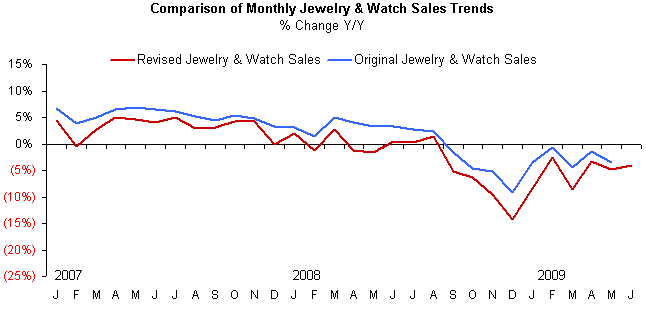
Because of newly revised monthly jewelry sales numbers, it is now clear that jewelry demand was weakening on a monthly basis much earlier than previously evident.
Revised Monthly Sales Comparisons Show Magnitude of Decline in 2008
Last month, IDEX Online Research reported that the U.S. Department of Commerce had made a major revision in its retail sales numbers which essentially reduced 2008 U.S. jewelry industry sales from $65 million to about $60 million. Further, we published restated jewelry industry sales numbers back to 1993 (the Department of Commerce did not revise jewelry sales numbers prior to that year, though it did revise some industries back to the 1950s).
The revised jewelry sales figures from the Department of Commerce show that jewelry and watch sales were much weaker than previously reported, especially heading into the current recessionary environment.
Some jewelers maintain “flash reports” which compare their monthly sales to industry sales. If you are one of those jewelers, you should use the data at the end of this article to revise your report. Many jewelers tell us that they use these numbers when talking with their banker. The revised numbers will take some of the pain out of those discussions.
We note that there have not been significant revisions to the Commerce Department’s sales data for specialty jewelers. The revisions include only total jewelry sales by all retail merchants, including specialty jewelers, discounters, mass marketers, online merchants and any retailer who sells jewelry.
New Data Vs Old Data
The graph below compares the new jewelry industry sales data with the previously published data. With only a few exceptions, the Commerce Department reflected directional demand trends accurately – one notable exception occurred during the spring of 2008 when jewelry sales were actually much weaker than initially reported.
Source: US Dept of Commerce
Jewelry Industry Sales Vs Specialty Jewelers’ Sales Reflects Historic Trends
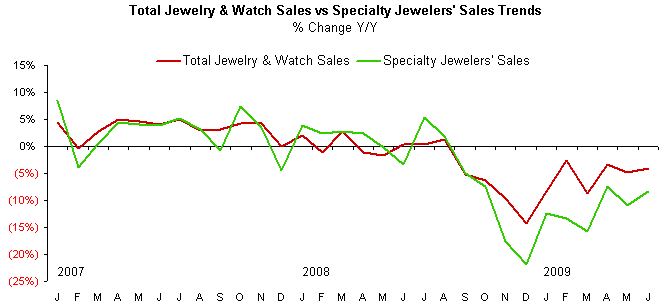
Historically, specialty jewelers’ sales fall faster and further than total jewelry industry sales during a recessionary environment. As the graph below illustrates, specialty jewelers’ sales tracked closely with total jewelry sales through much of 2008. However, by the fourth quarter of 2008, specialty jewelers’ sales were falling faster and further than total industry sales, a trend that continues through the first half of 2009.
The red line illustrates total jewelry industry sales trends, while the green line summarizes specialty jewelers’ sales trends on a monthly basis since the beginning of 2007.
Source: US Dept of Commerce
Watch Sales Have Been Especially Weak
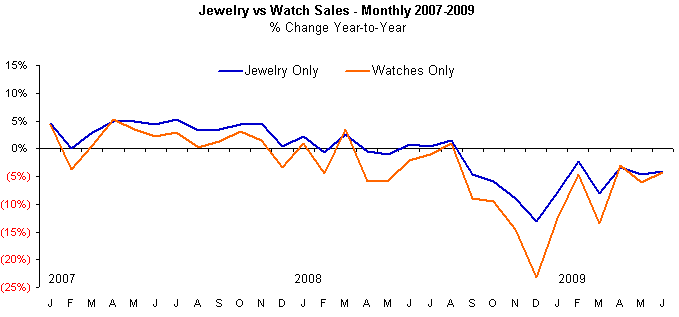
The government is now reporting monthly jewelry sales data in three categories: total jewelry and watch sales, jewelry (only) sales, and watch (only) sales. This sales data confirms our earlier research: watch sales are roughly 12 percent of total jewelry industry sales, though they dipped to 11 percent of total industry sales in 2008.
Jewelers reported that sales of watches have been especially weak, due to a number of factors: 1) the recessionary environment; 2) generally weaker demand for branded goods; 3) lack of demand for goods which would be considered conspicuous consumption; and 4) more consumers who refer to their mobile phones for the time.
The new data confirms that watch sales have been much weaker than jewelry sales, as the graph below illustrates. It is clear that demand for watches weakened substantially beginning in September 2008.
Source: US Dept of Commerce
Conclusion: The Government Does the Best It Can
IDEX Online Research was contacted by the government early this year, when the data revisions were being considered. Here’s the Cliff Notes version of our comments to them: 1) monthly jewelry sales numbers are too optimistic; and 2) total jewelry industry sales are overstated by a couple of billion dollars. After pushing the numbers around, the government decided that jewelry industry sales were overstated by $5 billion, not “a couple of billion” as we had suggested.
Why is government data revised frequently, and sometimes with great magnitude? In part, the government’s sampling techniques may be skewed. Statisticians use reports from jewelers. If jewelers are sloppy about the data they report, then industry numbers are skewed. The data also has to “foot and cross.” Retail sales are compared to consumer spending data. Retailers often under-report their sales, especially retailers who engage in cash transactions. Consumers often over-report their spending for a variety of reasons. At the end of the day, retail sales and consumer retail expenditures should be roughly equal. Thus, the government statisticians adjust the raw numbers.
We believe that the government gets the numbers more or less correct on a directional basis, but we caution jewelers about taking numbers past the first decimal place: there is too much room for error. Besides, strategic decisions should be based on broad trends, and the government gets those broad trends correct virtually all of the time on an annual basis, and mostly correct on a monthly basis.
Revised Data
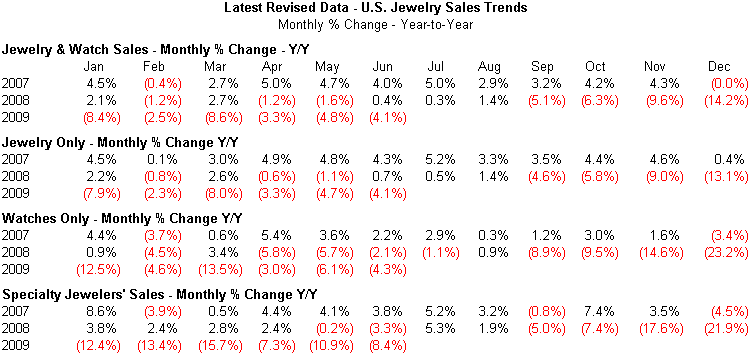
The following table summarizes the monthly percentage change in total jewelry sales, jewelry (only) sales, watch (only) sales on a year-over-year basis, and specialty jewelers’ sales (this data was mostly unrevised). In 2008, total U.S. jewelry industry sales were approximately $60.0 billion; specialty jewelers’ sales were about $28.3 billion.
Source: US Dept of Commerce