
IDEX Online Research: Jewelry Price Inflation Moderates in February (Full Report)
March 24, 10
After flaring in late 2009, jewelry prices at both the retail level and the supplier level continued to moderate in February 2010. While there are some fundamental reasons that jewelry price pressure has moderated, much of the cyclicality that the industry is currently experiencing is related to natural cycles that often occur in the immediate post-recession period.
The transition from a recessionary environment to a growth environment is fraught with false starts; it is not a smooth process. At each stage of the distribution pipeline, merchants test the ability of the next link to tolerate higher prices. After all, most merchants are intent on making up for lost sales volume and especially lost profits during the recessionary period.
As we noted in our analysis of jewelry price inflation for the month of January 2010, there are three key fundamental factors keeping the lid on prices in the jewelry industry, in addition to the ups and downs associated with a transitioning economy:
· Lack of seasonal demand – After coming off the all-important November-December 2009 holiday selling season, jewelers still have not begun major re-stocking efforts. February’s Valentine’s sales were solid, but did not have the vigor and zest that some jewelers and suppliers had hoped to see.
· Stable commodity prices – In particular, gold and silver prices appear to have moderated very modestly so far this year. This has taken some of the pressure off gold jewelry producers as well as low-end silver jewelry producers to raise prices. Unfortunately, platinum prices seem to be on the rise due to demand for platinum in other industries. The good news is that platinum jewelry accounts for only an estimated 2-3 percent of total U.S. jewelry sales, so platinum price inflation is not having a negative impact on overall industry demand.
· Relatively stable currency exchange rates – Since the beginning of the year, currency valuations have been generally stable versus the U.S. dollar. Thus, currency fluctuations have had a minimal impact on prices. In 2009, the U.S. dollar weakened against many other currencies, thus introducing inflationary pressure to jewelry prices, especially for goods produced overseas.
February Jewelry Inflation Continues to Moderate At Producer Level
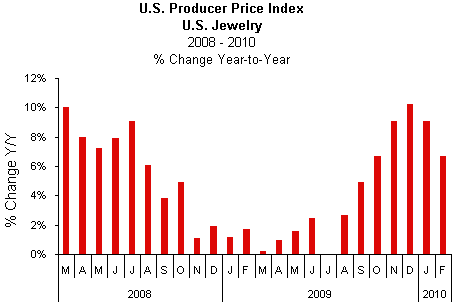
During February, jewelry price inflation was up 6.7 percent at the producer level on a year-over-year basis, as measured by the Jewelry Producer Price Index. While this is a very high level of inflation, it represents a decline from the 10.2 percent inflation rate recorded in December 2009 and the 9.1 percent inflation rate in January 2010.
The following graph illustrates the monthly inflation rate at the jewelry producer level for the past two years. It is clear that inflation surged at the producer level during the last four months of 2009, after remaining relatively calm earlier in 2009. However, since the beginning of the year, jewelry producer price inflation moderated.
Source: BLS
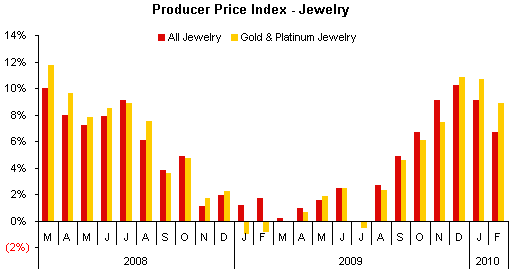
On an underlying basis, precious metal jewelry – primarily gold merchandise – showed greater inflation at the producer level than all jewelry. Total jewelry price inflation at the wholesale level was up 6.7 percent in February; price inflation for gold and platinum jewelry rose by 8.9 percent.
The graph below compares price inflation trends for all jewelry versus precious metal jewelry by month for the trailing twenty-four months. After being relatively tame earlier in 2009, wholesale prices of precious metals jewelry began to rise sharply in the fourth quarter, peaking in December 2009.
 Source: BLS |
Watch Price Inflation Lower At Producer Level in February
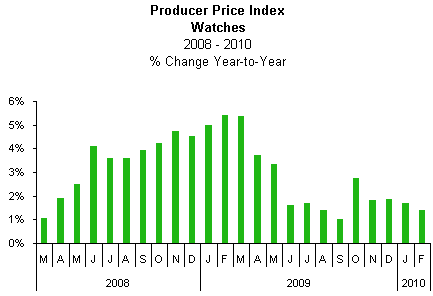
While jewelry price inflation has been on a roller coaster ride over the past few months, watch price inflation has been relatively stable. Further, there has been very little inflation at the producer level for watches. Fine watch prices were up a very modest 1.4 percent at the producer level during the month of February, down from a 1.7 percent inflation rate in January. Unfortunately, demand for watches has remained weak; thus, watch producers have little or no pricing power.
The graph below illustrates month-by-month price inflation trends for fine watches at the producer level during the past twenty-four months.
Source: BLS
Jewelry Retail Prices Experience Deflation in February
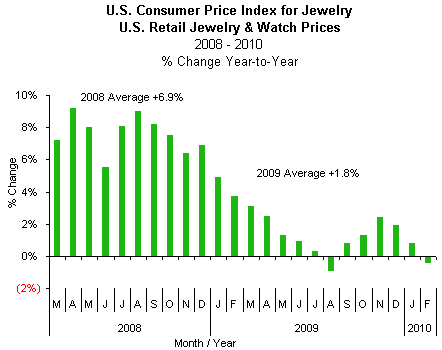
During February, retail prices for jewelry and watches declined by a very modest 0.4 percent, continuing a downhill trend which began earlier this year. This deflation is probably related to the post-recession cyclicality that is typical. During the recession, jewelry retail prices declined only one month – August 2009. Otherwise, they were stable or rose modestly, despite weak demand.
The graph below illustrates monthly retail jewelry price inflation for the past two years.
Source: BLS
Underlying Components of JCPI Show Disparity in February
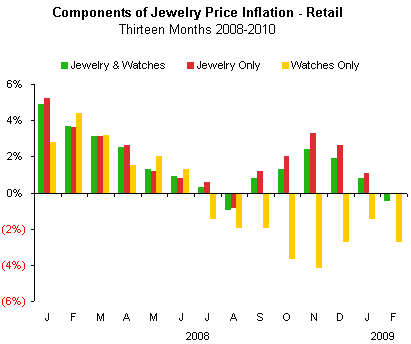
Jewelry prices were flat, while retail watch prices fell by 2.7 percent during the month of February, when compared to the same month in 2009. Overall, the Jewelry Consumer Price Index (JCPI) was down 0.4 percent. The continuing decline in fine watch prices is no surprise, since watch prices at the producer level showed little movement. Watches showed price deflation at the retail level for virtually every month during the second half of 2009.
In contrast, retail prices of jewelry moved higher in the final half of 2009, driven largely by higher precious metals prices and the prospects for improving consumer demand, though retail price inflation for jewelry moderated during December and January.
The graph below compares the overall inflation rate for jewelry and watches by month to each of the component inflation rates – jewelry and watches separately.
|
|
Jewelry Producer Inflation Continues to Outpace Jewelry Retail Price Increases
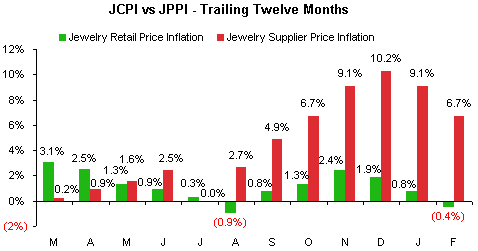
The margin squeeze is real: jewelry producer prices have risen higher and faster than retail jewelry prices during the final half of 2009 and into 2010. Obviously, retailers are absorbing most of the price increase imposed by the suppliers.
The graph below compares retail jewelry prices and producer jewelry prices on a monthly basis for the trailing twelve months.
 Source: BLS |
Outlook: Retail Jewelry Prices Are Headed Higher; Watch Price Inflation Less Likely
With the stock market up and with the housing market beginning to strengthen, investors and consumers who were looking at gold as a “safe harbor” are turning their attention elsewhere.
However, while prices of key precious metals used in jewelry have stabilized, polished diamond prices are on the rise. It takes about a year for diamond jewelry inventory to turn at the retail level, so new goods coming into a retail store will necessarily be priced higher than existing goods in inventory, simply to reflect the rising cost of diamonds. Since diamonds and diamond jewelry account for roughly half of all jewelry sales in America, price inflation at the retail level will become evident as we move through 2010.
Further, strengthening jewelry demand has translated into improved jewelry sales for retailers. As jewelry sales have perked up, inflation has returned to the industry.
It is difficult to forecast watch prices. Luxury buyers have been on holiday for the past two years, but appear to be returning to the market. However, more consumers have forsaken their watches in favor of checking the time with their mobile phones, computers and other electronic gadgets.