
IDEX Online Research: Jewelry Price Inflation Flares in March
May 10, 10
Jewelry price inflation suddenly flared in March, both at the producer level and at the consumer level, after subsiding for the past few months.
Late last summer, inflation began to rise as suppliers and retailers tested the market to see how much prices could be raised without significantly dampening demand. When demand flagged in early 2010, price pressures lessened.
Now, however, jewelry prices are rising as higher precious metals prices – most of which were incurred in 2009 – are finally working through the distribution channel. Further, because demand at the retail level remains solid both suppliers and retail merchants have pushed prices higher in an effort to recover some of the margin erosion which has occurred over the past two years.
March 2010 Jewelry Price Inflation Up Sharply
The key jewelry industry inflation statistics for March 2010 – as compared to March 2009 – are as follows:
· Jewelry Producer Price Index (JPPI) = +11.4%
o Precious Metal Jewelry = +12.5%
o Watches = +1.5%
· Jewelry & Watch Consumer Price Index (JCPI) = +1.1%
o Jewelry Consumer Price Inflation = +1.7%
o Watch Consumer Price Inflation = (-2.9%)
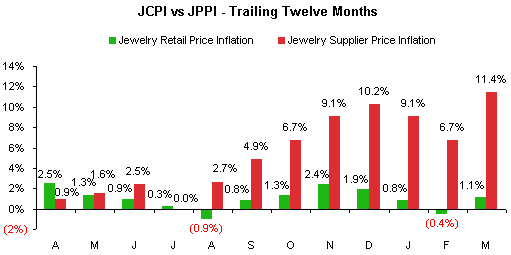
Even though retail jewelry prices were up only modestly in March at +1.1 percent, there is substantial pricing pressure from suppliers whose prices advanced by a dramatic 11.4 percent on a year-to-year basis. This means that retail prices are expected to rise sharply later this year.
Jewelry Producer Price Inflation Up Sharply
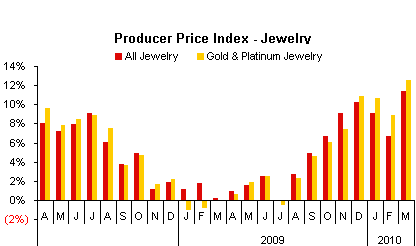
Producer prices for jewelry rose sharply in March by 11.4 percent, when compared to March 2009, driven primarily by higher prices of precious metal jewelry – mostly gold.
The graph below summarizes both jewelry price inflation (red bars) and precious metals price inflation (yellow bars) at the producer level.
Source: BLS
Jewelry Consumer Price Inflation Up Modestly in March
Along with jewelry producer inflation, jewelry prices at the consumer level also rose in March by 1.1 percent versus March 2009.
In part, these price increases were driven by higher wholesale prices. In addition, some retail jewelers have begun to raise prices in an effort to recoup margin erosion which has occurred over the past two years. For example, Sterling Jewelers noted that they have raised prices on about 30 percent of their merchandise – primarily those items with a high gold and precious metal content.
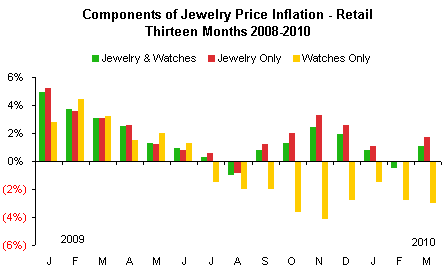
On a segment basis, retail prices for jewelry – excluding watches – rose by 1.7 percent during March. We think that reflects some price increases which merchants implemented earlier this year.
In contrast, retail watch prices fell by 2.9 percent in March. There are several reasons for this price action: 1) more younger consumers are using their electronic devices to tell what time it is; 2) branding allows easy watch price comparisons, keeping a lid on prices; and 3) consumers are purchasing fewer high-ticket discretionary items such as watches. The LGI Network, which tracks watch sales volume, also reports that sales have been stronger among lower-priced watches than among the higher priced units (except those with a retail price of $5,000 and higher – a very low-volume segment).
The graph below illustrates jewelry and watch price inflation at the retail level.
Source: BLS
Outlook: Inflation Won’t Go Away
Last month, we said that while inflation appears to be cooling somewhat, we believe that it is a temporary situation. Minor cycles like this often occur as the global economy exits a recession. Markets are tested for the inflation tolerance.
Clearly, March jewelry price inflation numbers provide evidence that inflation is here to stay.
In the case of the jewelry industry, suppliers are pushing prices higher – as shown on the graph below illustrates (red bars), but retailers have not been passing along those increases. So far, retail merchants have held prices relatively firm at retail (green bars). This situation has created a disequilibrium among prices in the industry. It cannot continue at this pace. Either suppliers will be forced to roll back prices, or retailers must raise prices.
Source: BLS
Longer term, as the global economy heats up, there will be increasing demand for “hard assets” – specifically commodities including gold, platinum, silver, palladium and diamonds – both from investors as well as end users in other industries. All of those commodities are major cost components of jewelry.
Further, polished diamond prices are already on the rise. It takes about a year for diamond jewelry inventory to turn at the retail level, so new goods coming into a retail store will necessarily be priced higher than existing goods in inventory, simply to reflect the rising cost of diamonds. Since diamonds and diamond jewelry account for roughly half of all jewelry sales in America, price inflation at the retail level will become evident as we move through 2010.
It is difficult to forecast watch prices. Luxury buyers have been on holiday for the past two years, but appear to be returning to the market. However, more consumers have forsaken their watches in favor of checking the time with their mobile phones, computers and other electronic gadgets.
Retailers are faced with a major dilemma: consumers are seeking a value – better quality goods for a low price – but they also are seeking low price-point merchandise. The quality of merchandise at the “hot” $99 retail price point has deteriorated, and will continue to decline until it becomes junk jewelry. Somehow, consumers will need to be re-educated: you can’t have something for nothing.